EPFO to Invest Your PF Money in Startups? What the 3% Plan Means for You
EPFO is preparing rules to invest up to 3% of its fresh yearly inflows in Category I and II AIFs and startup funds. Here is what is proposed and what it means for your PF.

On this page 6 sections
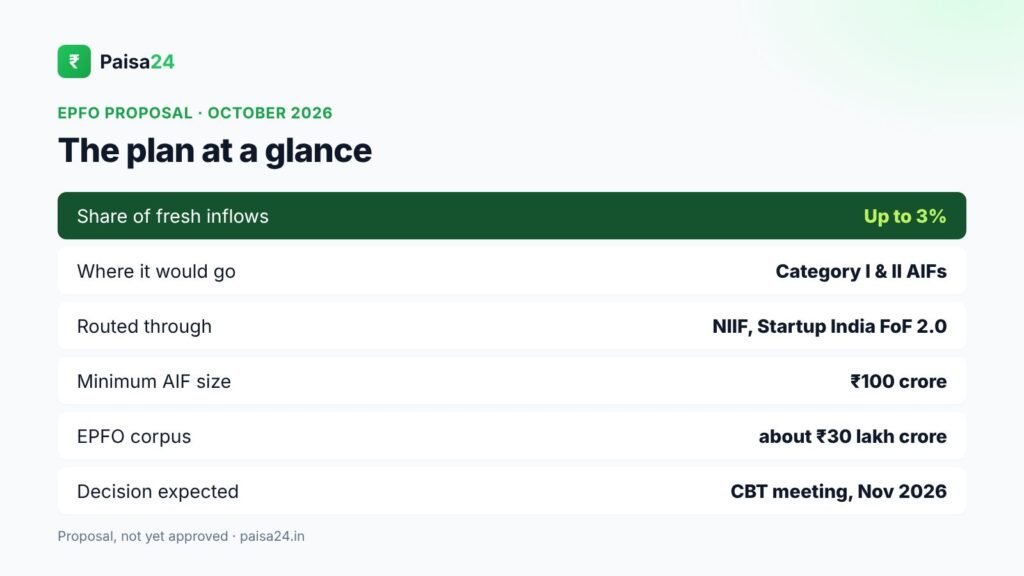
The Employees’ Provident Fund Organisation (EPFO) is preparing rules to invest up to 3% of its fresh yearly inflows in startups and alternative investment funds (AIFs). The proposal is expected to go to EPFO’s Central Board of Trustees (CBT), headed by Labour Minister Mansukh Mandaviya, in November 2026. It is not final yet. Here is what is proposed, the safeguards being discussed, and what it could mean for the PF money of nearly 30 crore members.
Quick answer: Your PF balance and interest are not affected right now. The plan covers only a small slice (up to 3%) of new money EPFO receives each year, would go through government-backed funds, and still needs CBT approval.
Key takeaways
- EPFO may invest up to 3% of fresh annual accretions in SEBI-registered Category I and II AIFs.
- Initially, the money would go through the National Investment and Infrastructure Fund (NIIF) and SIDBI’s Startup India Fund of Funds 2.0.
- Proposed safeguards include a ₹100 crore minimum fund size, limits per fund and no investment in foreign-incorporated entities.
- EPFO manages about ₹30 lakh crore for nearly 30 crore members; it has never invested in AIFs before.
- The government first allowed these investment avenues about five years ago; EPFO is only now writing the rules.
What exactly is EPFO proposing?
Under the finance ministry’s investment pattern, EPFO can already put up to 5% of fresh accretions in “asset-backed, trust-structured and miscellaneous” investments. Within this, it is now considering allocating up to 3% to Category I and II AIFs. The trigger was a letter from the Department for Promotion of Industry and Internal Trade (DPIIT) in September, asking EPFO to take part in the Startup India Fund of Funds 2.0.
| Fund type | What it invests in |
|---|---|
| Category I AIF | Startups, venture capital, small businesses, infrastructure and social ventures |
| Category II AIF | Private equity, private debt and real estate funds |
Safeguards on the table
- Only large funds: AIFs must have a minimum corpus of ₹100 crore.
- Exposure caps: limits on how much EPFO can put into any single fund.
- India only: no investment in foreign-incorporated entities.
- Independent managers: rules to ensure fund managers are independent.
- Government-backed routes first: NIIF and SIDBI’s fund of funds, rather than picking startups directly.
What it means for your PF
For most members, nothing changes in the short term. Your contributions, your balance and how you withdraw stay the same. The bigger question is the EPF interest rate, which is 8.25% for FY 2025-26 and is set each year from EPFO’s overall earnings.
| Possible effect | Why |
|---|---|
| Slightly higher long-term returns | Private equity and venture funds can earn more than bonds over 7 to 10 years |
| More volatility in earnings | AIF returns are uneven and take years to show, and some startups fail |
| Lower liquidity | AIF money is locked for 7 to 10 years and cannot be sold quickly |
| Very small overall impact | 3% of new money is a tiny part of a ₹30 lakh crore corpus, most of which stays in government bonds |
Since 2015 EPFO has also invested part of its inflows in equity ETFs, and EPF has continued to pay a stable rate. A capped, small AIF allocation is unlikely to move your interest rate much either way.
Want more equity exposure yourself? Your EPF is mostly debt. If you are young, a monthly SIP in an index fund can complement it. See what a ₹5,000 SIP or ₹1,000 SIP can grow to.
Other EPFO updates this month
- ECR deadline extended: EPFO extended the deadline for employers to file the September 2026 ECR and deposit PF contributions to 31 October 2026. Check your passbook in early November to make sure your September contribution is credited.
- Higher wages under the labour codes: with “wages” now at least 50% of pay, many employees see higher PF deductions. See how it affects take-home in 12 LPA in-hand salary and gratuity in our gratuity formula guide.
Frequently asked questions
Is EPFO investing PF money in startups?
It is proposing to. EPFO may invest up to 3% of fresh yearly inflows in Category I and II AIFs, including startup funds. The CBT is expected to consider the proposal in November 2026.
Is my PF money safe?
Yes. The plan covers only a small share of new inflows, with safeguards like a ₹100 crore minimum fund size and caps per fund. Most of the corpus remains in government and high-rated bonds.
Will the EPF interest rate change because of this?
Not in the near term. The rate is set each year based on overall earnings, and a 3% allocation of new money is too small to change it much.
What is the current EPF interest rate?
8.25% for FY 2025-26.
What is the September 2026 ECR due date?
EPFO extended it to 31 October 2026.
Related guides and calculators
- CTC vs in-hand salary
- Gratuity calculation formula 2026
- Money rule changes from 1 November 2026
- SIP of ₹1,000 returns
- Salary calculator
Sources: EPFO · Business Standard · Ministry of Labour and Employment. Last checked 30 October 2026. Figures are estimates for guidance, not tax or financial advice. How we research and fact-check.
This guide is for information only and isn’t financial advice. Rates, fees and rules change — always confirm on the official website before you decide. Read our disclaimer.