SIP of ₹1,000 a Month: How It Becomes ₹9.99 Lakh (or ₹88 Lakh)
A SIP of ₹1,000 a month can grow to about ₹9.99 lakh in 20 years at 12%. See the returns table for 5 to 30 years, the step-up effect and how to start.

On this page 9 sections
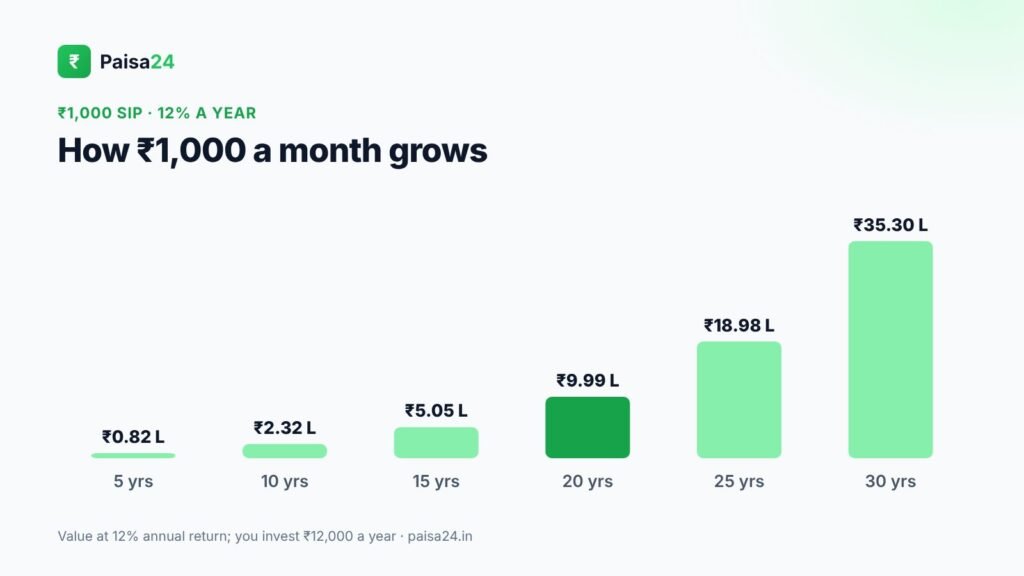
A SIP of ₹1,000 a month can grow to about ₹9.99 lakh in 20 years at a 12% annual return. In 10 years it becomes about ₹2.32 lakh, in 15 years about ₹5.05 lakh and in 25 years about ₹18.98 lakh. Leave it for 30 years and it crosses ₹35 lakh, almost ten times the ₹3.6 lakh you put in. Below is the full returns table at 10%, 12% and 14%, the power of a yearly step-up, how ₹1,000 compares with an RD or PPF, and how to start today.
Quick answer: ₹1,000 SIP at 12%: ₹2.32 lakh in 10 years, ₹5.05 lakh in 15 years, ₹9.99 lakh in 20 years, ₹18.98 lakh in 25 years and ₹35.30 lakh in 30 years.
Key takeaways
- SIP of ₹1,000 for 20 years: you invest ₹2.4 lakh and it grows to about ₹9.99 lakh at 12%.
- Over 30 years the gain (about ₹31.7 lakh) is nearly nine times what you invested.
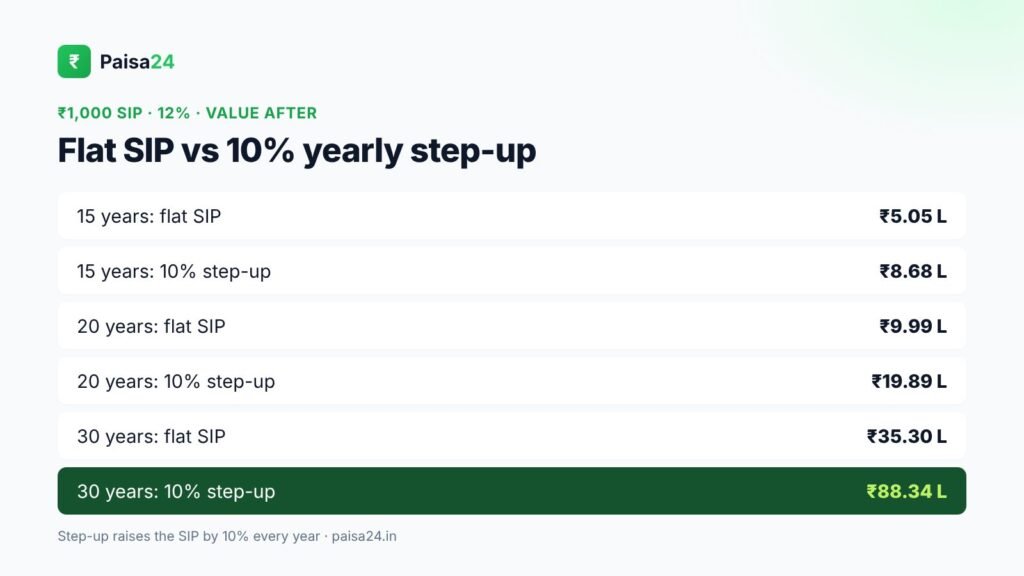
- Raising the SIP by 10% every year doubles the 20-year result to about ₹19.89 lakh.
- Starting at 25 instead of 35 turns the same ₹1,000 into about ₹65 lakh by 60, instead of ₹19 lakh.
- Most mutual funds accept SIPs from ₹100 to ₹500, so ₹1,000 is enough to own two diversified funds.
SIP of ₹1,000: returns table
The table shows the estimated value of a ₹1,000 monthly SIP at three return levels. Large-cap and flexi-cap equity funds have historically delivered around 10% to 14% a year over long periods, though returns are never guaranteed.
| Period | Invested | At 10% | At 12% | At 14% |
|---|---|---|---|---|
| 5 years | ₹60,000 | ₹78,082 | ₹82,486 | ₹87,201 |
| 10 years | ₹1,20,000 | ₹2,06,552 | ₹2,32,339 | ₹2,62,091 |
| 15 years | ₹1,80,000 | ₹4,17,924 | ₹5,04,576 | ₹6,12,854 |
| 20 years | ₹2,40,000 | ₹7,65,697 | ₹9,99,148 | ₹13,16,346 |
| 25 years | ₹3,00,000 | ₹13,37,890 | ₹18,97,635 | ₹27,27,278 |
| 30 years | ₹3,60,000 | ₹22,79,325 | ₹35,29,914 | ₹55,57,056 |
Look at the last two rows: the money roughly doubles every five to six years at 12%. Most of the growth comes in the final decade, so the single biggest factor is how long you stay invested, not how much you start with.
Free calculatorCalculate your own SIP returnsMonthly SIP, step-up or lumpsum — watch it compound.The formula behind the numbers
SIP maturity is calculated as M = P × [(1 + i)n − 1] ÷ i × (1 + i), where P is the monthly SIP (₹1,000), i is the monthly return (12% ÷ 12 = 1%) and n is the number of instalments (240 for 20 years). Plugging in: 1,000 × [(1.01)240 − 1] ÷ 0.01 × 1.01 ≈ ₹9,99,148.
SIP of ₹1,000 with a 10% yearly step-up
A step-up SIP increases your instalment every year, usually in line with your salary hike. With a 10% step-up, your ₹1,000 becomes ₹1,100 in year two, ₹1,210 in year three and so on.
| Period | Total invested | Value at 12% (step-up) | Value without step-up |
|---|---|---|---|
| 10 years | ₹1,91,249 | ₹3,37,433 | ₹2,32,339 |
| 15 years | ₹3,81,270 | ₹8,68,385 | ₹5,04,576 |
| 20 years | ₹6,87,300 | ₹19,88,872 | ₹9,99,148 |
| 25 years | ₹11,80,165 | ₹42,75,546 | ₹18,97,635 |
| 30 years | ₹19,73,928 | ₹88,34,124 | ₹35,29,914 |
With a step-up, even a ₹1,000 start can reach ₹1 crore in about 31 years. Without it, the same ₹1,000 would take about 39 years. For bigger targets, see how much SIP you need for ₹1 crore.
The cost of starting late
Here is what ₹1,000 a month at 12% becomes by age 60, depending on when you start:
| Start age | Years invested | Amount invested | Value at 60 |
|---|---|---|---|
| 25 | 35 | ₹4.2 lakh | about ₹65 lakh |
| 30 | 30 | ₹3.6 lakh | about ₹35.3 lakh |
| 35 | 25 | ₹3.0 lakh | about ₹19 lakh |
Waiting just ten years, from 25 to 35, costs you about ₹46 lakh, even though you would invest only ₹1.2 lakh less. Time in the market matters more than the amount.
SIP of ₹1,000 vs RD vs PPF
If you are deciding where to put ₹1,000 a month, here is how the three popular options compare over 20 years:
| Option | Expected return | Value after 20 years | Risk | Lock-in |
|---|---|---|---|---|
| Equity mutual fund SIP | about 12% (not guaranteed) | about ₹9.99 lakh | Market-linked | None (3 years for ELSS) |
| Bank recurring deposit | about 7% (fixed) | about ₹5.2 lakh | Very low | Chosen tenure |
| PPF (₹12,000 a year) | 7.1% (tax-free) | about ₹5.3 lakh | Very low | 15 years |
An equity SIP can nearly double the result of an RD or PPF over 20 years, but it moves with the market. A sensible approach for beginners is to split: equity SIP for long-term goals and PPF or an RD for safety. Check the latest small savings rates before you decide.
What about inflation and tax?
- Inflation: at 6% inflation, ₹9.99 lakh in 20 years will buy roughly what ₹3.1 lakh buys today. That is why a step-up SIP is so important.
- Tax: equity fund gains held over a year are long-term capital gains, taxed at 12.5% above ₹1.25 lakh of gains a year. Short-term gains (under one year) are taxed at 20%. Selling gradually across years can keep most of your gains under the ₹1.25 lakh limit.
- Tax saving: a ₹1,000 SIP in an ELSS fund counts towards the 80C limit if you use the old regime. See the 80C deductions list.
Best ways to invest ₹1,000 a month
- One flexi-cap or Nifty 50 index fund. Simple, low-cost and diversified. Ideal if ₹1,000 is your whole SIP.
- Split ₹500 + ₹500. An index fund plus a flexi-cap or mid-cap fund, if your goal is 10+ years away.
- Choose the direct plan. Direct plans have lower expense ratios than regular plans, which adds up to thousands over 20 years.
- Set the SIP date just after salary day and turn on the yearly step-up option most apps now offer.
- Never stop in a market fall. Falls buy you more units at lower prices, which is exactly how SIPs build wealth.
How to start: complete your KYC once (PAN, Aadhaar and a selfie) on any SEBI-registered platform or the fund house website, pick a direct plan, choose ₹1,000 and your SIP date, and set up a UPI AutoPay or bank mandate. It takes about 10 minutes.
Frequently asked questions
What will a SIP of ₹1,000 be worth after 10 years?
About ₹2.32 lakh at 12%, ₹2.07 lakh at 10% and ₹2.62 lakh at 14%. You invest ₹1.2 lakh in total.
What is the return on a ₹1,000 SIP for 20 years?
About ₹9.99 lakh at 12%, of which ₹2.4 lakh is your investment and about ₹7.59 lakh is gains.
Can a ₹1,000 SIP make me a crorepati?
Yes, but slowly. At 12% a flat ₹1,000 SIP takes about 39 years to reach ₹1 crore. With a 10% yearly step-up it takes about 31 years.
Is a ₹1,000 SIP worth it?
Yes. It builds the habit, gets you market-linked growth and can be raised later. Over 30 years ₹1,000 a month can grow to about ₹35 lakh at 12%.
Which is better, a ₹1,000 SIP or RD?
For goals more than five years away, a SIP in an equity fund has historically beaten an RD by a wide margin. For goals under three years, an RD is safer.
What is the minimum SIP amount in India?
Most funds allow SIPs from ₹500, and many now accept ₹100 to ₹250 a month.
Related guides and calculators
- SIP of ₹2,000 for 10 to 25 years
- SIP of ₹5,000 for 10 to 25 years
- SIP of ₹10,000 for 10 to 25 years
- How much SIP for ₹1 crore?
- SIP calculator
- FD vs SIP calculator
Sources: AMFI · SEBI · Income Tax Department. Last checked 30 October 2026. Figures are estimates for guidance, not tax or financial advice. How we research and fact-check.
This guide is for information only and isn’t financial advice. Rates, fees and rules change — always confirm on the official website before you decide. Read our disclaimer.