80C Deductions List 2026-27: All Options Compared
Every 80C deduction compared: ELSS, PPF, Sukanya Samriddhi, NSC, tax-saver FD and more, with returns, lock-in, tax saved and the best picks for you.
On this page 9 sections
- 01What are 80C deductions?
- 02How much tax can 80C deductions save?
- 03The complete 80C deductions list
- 04Which 80C deductions are best for you?
- 05Example: filling your 80C deductions smartly
- 06How to plan your 80C deductions in 4 steps
- 07Common mistakes with 80C deductions
- 0880C deductions vs other deductions
- 09Frequently asked questions
80C deductions let you cut up to ₹1.5 lakh from your taxable income every year, which can save you up to ₹46,800 in tax. However, they work only in the old tax regime, and not every option suits everyone. This guide lists every 80C option, compares returns, lock-in and risk, and shows you which ones make sense for your goals.
Key takeaways
- The 80C limit is ₹1.5 lakh a year, shared across all options.
- They work only in the old regime; the new regime does not allow them.
- Under the Income Tax Act, 2025, Section 80C is now Section 123, but the limit and options are the same.
- ELSS has the shortest lock-in (3 years); PPF and Sukanya Samriddhi give tax-free, government-backed returns.
What are 80C deductions?
80C deductions come from Section 80C of the old Income Tax Act, which let you deduct certain investments and expenses from your income before tax. From 1 April 2026, the Income Tax Act, 2025 moved this benefit to Section 123. Still, almost everyone still calls it 80C, and the rules did not change.
The total limit is ₹1.5 lakh a year. So if you invest ₹1 lakh in PPF and ₹1 lakh in ELSS, you can still deduct only ₹1.5 lakh in total.
How much tax can 80C deductions save?
Your saving from 80C deductions depends on your tax slab in the old regime. Here is what a full ₹1.5 lakh deduction is worth, including 4% cess:
| Your old-regime slab | Tax saved on ₹1.5 lakh |
|---|---|
| 5% | ₹7,800 |
| 20% | ₹31,200 |
| 30% | ₹46,800 |
Important: If you are in the new regime, 80C deductions save you nothing. So first check which regime suits you in our new vs old tax regime guide.
The complete 80C deductions list
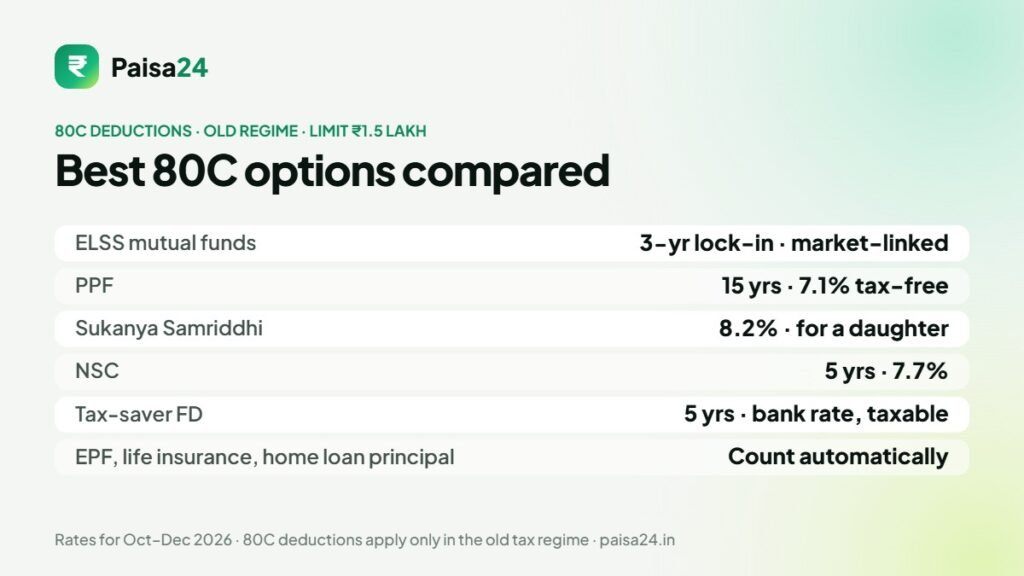
Here are all the major 80C deductions, with current returns and lock-in periods. The government resets small savings rates every quarter; the rates below apply for October to December 2026.
| 80C deductions | Return | Lock-in | Tax on returns |
|---|---|---|---|
| ELSS mutual funds | Market-linked | 3 years | LTCG tax above the yearly limit |
| Public Provident Fund (PPF) | 7.1% | 15 years (partial withdrawal from year 7) | Tax-free |
| Sukanya Samriddhi Yojana | 8.2% | Till the girl turns 21 (partial at 18) | Tax-free |
| National Savings Certificate (NSC) | 7.7% | 5 years | Interest taxable |
| Senior Citizens Savings Scheme (among 80C deductions for 60+) | 8.2% | 5 years | Interest taxable |
| 5-year tax-saver bank FD | Bank rate | 5 years | Interest taxable |
| Employee Provident Fund (your share) | Set yearly by EPFO | Till retirement / job change rules | Tax-free within limits |
| Life insurance premium | Depends on policy | Policy term | Usually tax-free |
| Home loan principal repayment | — | — | — |
| Children’s tuition fees (up to 2 children) | — | — | — |
| NPS (your own contribution) | Market-linked | Till 60 | Partly taxable at exit |
Remember that all of these options share one ₹1.5 lakh limit, so pick the mix rather than all of them.
Which 80C deductions are best for you?
There is no single best option. Instead, the right mix of 80C deductions depends on your goal and how long you can lock in money.
If you want growth: ELSS
Among 80C deductions, ELSS funds are the growth option: they invest mostly in shares. Because of that, they carry market risk, but they have historically delivered the highest long-term returns among 80C deductions. They also have the shortest lock-in, just 3 years. For instance, a ₹12,500 monthly SIP covers the full ₹1.5 lakh limit. Try our SIP calculator to see how it can grow.
If you want safety: PPF
Among safe 80C deductions, PPF stands out: the government backs it, and the interest is completely tax-free. As a result, a 7.1% tax-free return equals over 10% pre-tax for someone in the 30% slab. The catch is the 15-year lock-in. See the growth in our PPF calculator.
If you have a daughter: Sukanya Samriddhi
For parents of girls, the best of the 80C deductions is often Sukanya Samriddhi Yojana, which currently pays 8.2%, among the highest of any small savings scheme, and the returns are tax-free. In addition, you can open it for a girl child below 10 years of age.
Already covered without trying
Many salaried people use up a large part of their 80C deductions without investing anything extra. For example, your EPF contribution, life insurance premium, home loan principal and children’s school fees all count. So add these up first, and invest only the gap.
Example: filling your 80C deductions smartly
To see 80C deductions in practice, take Rahul, who earns ₹14 lakh, pays rent and chooses the old regime. First, his EPF contribution from his payslip comes to ₹72,000 a year. Next, his term insurance premium adds ₹12,000. So he already has ₹84,000 covered without doing anything new.
That leaves a gap of ₹66,000. Rahul splits it between an ELSS SIP of ₹4,000 a month (₹48,000 a year) and ₹18,000 in PPF. As a result, he uses the full ₹1.5 lakh limit and, at the 20% slab, saves ₹31,200 in tax, while building both market-linked and safe savings.
| Item | Amount |
|---|---|
| EPF (own share) | ₹72,000 |
| Term insurance premium | ₹12,000 |
| ELSS SIP (₹4,000 × 12) | ₹48,000 |
| PPF | ₹18,000 |
| Total 80C | ₹1,50,000 |
How to plan your 80C deductions in 4 steps
- Check your regime first. 80C deductions matter only in the old regime.
- Add what already counts: EPF from your payslip, insurance premiums, home loan principal and tuition fees.
- Fill the gap early in the year. A monthly ELSS SIP or PPF deposit spreads the cost and avoids a March rush.
- Keep proofs: submit them to your employer by the January–February deadline so that your employer deducts the right TDS.
Pro tip: Deposit in PPF before the 5th of each month. PPF earns interest on the lowest balance between the 5th and the last day of the month, so early deposits earn more.
Common mistakes with 80C deductions
- Buying insurance just to save tax: traditional endowment plans often return only 4–6%. Instead, buy term insurance for cover and invest separately.
- Rushing in March: last-minute decisions often lead to poor products. Plan in April instead.
- Forgetting the regime: if you move to the new regime, these investments no longer cut your tax, although they still build wealth.
- Going over the limit for tax reasons: anything above ₹1.5 lakh gives no extra 80C benefit.
80C deductions vs other deductions
80C deductions are only one part of the old regime. Beyond it, you can also claim 80D for health insurance and an extra ₹50,000 for NPS under 80CCD(1B). Together, these can push your deductions well past ₹2 lakh. That said, check whether the total beats the new regime for your salary before you commit.
Free calculatorSee how much your 80C deductions saveNew vs Old regime for FY 2026-27 — see which one saves you more, instantly.Frequently asked questions
What is the maximum limit for 80C deductions?
₹1.5 lakh a year in total, across all 80C options combined.
Is 80C allowed in the new tax regime?
No. These deductions, now Section 123 under the Income Tax Act, 2025, are available only in the old regime.
Which 80C option has the shortest lock-in?
ELSS mutual funds, with a 3-year lock-in.
Is PPF interest taxable?
No. PPF interest and the maturity amount are fully tax-free.
Does home loan principal count under 80C?
Yes. The principal part of your home loan EMI counts towards the ₹1.5 lakh limit, along with stamp duty and registration in the year you pay them.
Sources: Income Tax Department · National Savings Institute · Small savings rates Oct–Dec 2026 (Business Today). Last checked 21 October 2026. Figures are estimates for guidance, not tax or financial advice.
This guide is for information only and isn’t financial advice. Rates, fees and rules change — always confirm on the official website before you decide. Read our disclaimer.