SIP of 5000 for 10, 15 & 20 Years: How Much Will You Get?
What a SIP of ₹5,000 a month grows into over 5, 10, 15, 20 and 25 years, plus how a 10% yearly step-up turns it into almost ₹1 crore.
On this page 7 sections
A SIP of 5000 a month is one of the most common ways Indians start investing. But what can it actually become? At a 12% yearly return, it grows to about ₹11.6 lakh in 10 years and close to ₹50 lakh in 20 years. Below, we show the numbers for different periods and returns, explain why time matters more than amount, and show how a small yearly step-up changes everything.
Key takeaways
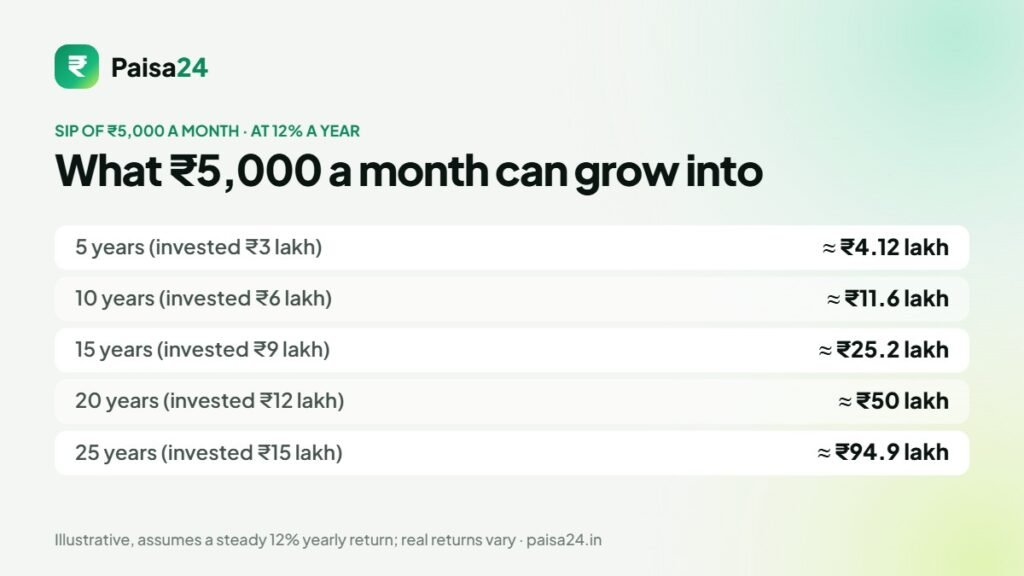
- At 12% a year, a SIP of 5000 grows to about ₹11.6 lakh in 10 years, ₹25.2 lakh in 15 years and ₹50 lakh in 20 years.
- Over 20 years, your own money is ₹12 lakh; the other ₹38 lakh is growth.
- Raising the SIP by 10% every year turns ₹5,000 into almost ₹1 crore in 20 years at 12%.
- Returns are not guaranteed; equity funds can fall sharply in some years.
SIP of 5000: returns at a glance
Here is what a SIP of 5000 can grow into at two return levels. A 10% return is a conservative long-term assumption for equity funds, while 12% is closer to what broad Indian equity has delivered over long periods in the past. Of course, past returns do not guarantee future ones.
| SIP of 5000 for | You invest | Value at 10% | Value at 12% |
|---|---|---|---|
| 5 years | ₹3,00,000 | ₹3.90 lakh | ₹4.12 lakh |
| 10 years | ₹6,00,000 | ₹10.33 lakh | ₹11.62 lakh |
| 15 years | ₹9,00,000 | ₹20.90 lakh | ₹25.23 lakh |
| 20 years | ₹12,00,000 | ₹38.28 lakh | ₹49.96 lakh |
| 25 years | ₹15,00,000 | ₹66.89 lakh | ₹94.88 lakh |
Why a SIP of 5000 grows so fast over time
Look closely at the table. Between years 15 and 20, the value at 12% almost doubles, even though you add only ₹3 lakh more. That is compounding: your returns start earning returns of their own. As a result, the last few years of a long SIP add far more money than the first few.
In other words, starting early matters more than starting big. For example, a SIP of 5000 started at 25 beats a SIP of ₹10,000 started at 35, if both stop at 55.
Step-up SIP: the easy way to reach ₹1 crore
Most people get a raise every year, so their SIP can rise too. If you increase your SIP of 5000 by 10% each year, here is the difference over 20 years at 12%:
| SIP of 5000 plan | You invest | Value after 20 years |
|---|---|---|
| Flat SIP of 5000 | ₹12.0 lakh | ≈ ₹50 lakh |
| ₹5,000 + 10% step-up every year | ₹34.4 lakh | ≈ ₹99.4 lakh |
So a small yearly increase almost doubles the final amount. Many fund houses and apps let you set an automatic yearly step-up when you start the SIP.
Where to start a SIP of 5000
Index funds
Index funds simply copy an index like the Nifty 50. Index funds have very low costs and suit beginners who want market returns without picking funds. You can model the growth in our SIP calculator.
Flexi-cap funds
These funds invest across large, mid and small companies. As a result, they offer wider diversification, though they cost more than index funds.
ELSS tax-saver funds
If you use the old tax regime, an ELSS SIP also cuts your tax under 80C, with a 3-year lock-in. See our 80C deductions guide for details.
Pro tip: Choose “direct” plans rather than “regular” plans. Direct plans skip the distributor commission, which can add up to lakhs over 20 years.
Tax on SIP returns
Equity mutual fund gains held for more than a year count as long-term capital gains. In addition, each unit of each SIP instalment has its own holding period, so units bought in the last 12 months count as short-term. Check current capital gains rates on the Income Tax Department website before you redeem.
Risks to keep in mind
- Market falls: equity funds can drop 20–40% in a bad year. Therefore, keep investing through falls; that is when SIPs buy cheap.
- Stopping early: most SIP growth comes in the later years, so stopping at year 5 or 7 loses the best part.
- No emergency fund: without one, you may have to sell at a bad time. A safe option like PPF can hold part of it; see our PPF calculator.
Finally, check a fund’s risk level and costs on AMFI before you invest. Mutual fund investments are subject to market risks.
Frequently asked questions
How much will a SIP of 5000 give in 10 years?
About ₹11.6 lakh at a 12% yearly return, or about ₹10.3 lakh at 10%. You invest ₹6 lakh of your own money.
Can a SIP of 5000 make me a crore?
Yes, over time. A flat ₹5,000 SIP crosses ₹1 crore in about 26 years at 12%. With a 10% yearly step-up, it reaches about ₹1 crore in 20 years.
Is a SIP of 5000 enough for beginners?
Yes. It is a strong start. The key is to keep it going for 10–20 years and raise it as your income grows.
What happens if I miss a SIP payment?
Nothing serious. The fund simply skips that month. After several missed payments, the SIP may be cancelled, but your units stay invested.
Are SIP returns guaranteed?
No. Equity SIP returns depend on the market and can be negative in some years. The figures here are illustrations, not promises.
Sources: AMFI · Income Tax Department. Last checked 21 October 2026. Figures are estimates for guidance, not tax or financial advice.
This guide is for information only and isn’t financial advice. Rates, fees and rules change — always confirm on the official website before you decide. Read our disclaimer.