CTC vs In-Hand Salary: What You Really Take Home (With Example)
CTC vs in-hand salary explained: PF, gratuity, professional tax and income tax, with a full ₹12 lakh CTC example and tips to raise your take-home pay.

On this page 8 sections
Your offer letter says ₹12 lakh, but your bank account sees about ₹85,000 a month. Why? The gap between CTC vs in-hand salary comes from PF, gratuity, professional tax and income tax. In this guide, we break down every part of your CTC so you know exactly what you will take home before you accept an offer.
Key takeaways
- CTC is what the company spends on you; in-hand salary is what reaches your bank after deductions.
- Employer PF and gratuity sit inside CTC but never reach your monthly pay.
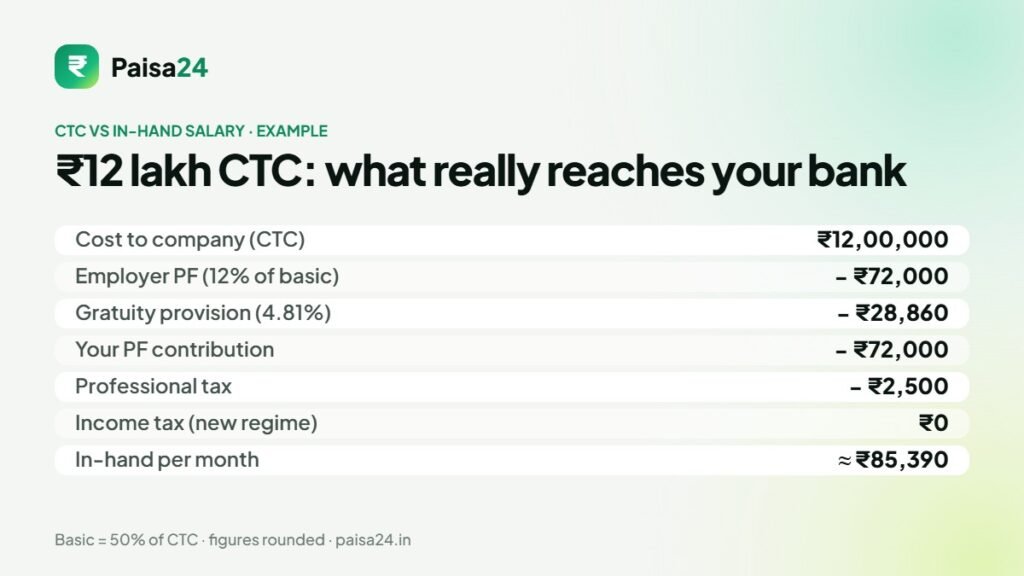
- On a ₹12 lakh CTC with 50% basic, in-hand pay is about ₹85,000 a month in the new regime.
- A higher basic means more PF and gratuity, which lowers in-hand pay today but builds savings.
What is CTC vs in-hand salary?
CTC (cost to company) is the total amount your employer spends on you in a year. It includes your salary, plus things you never receive in cash each month, such as the employer’s PF contribution and gratuity. In contrast, in-hand salary (or take-home pay) is the money that actually lands in your bank account after all deductions.
In short: CTC − employer-side costs = gross salary, and gross salary − your deductions = in-hand salary.
The parts of your CTC
| Component | What it is | Reaches your bank monthly? |
|---|---|---|
| Basic salary | Core pay, usually 40–50% of CTC | Yes |
| House rent allowance (HRA) | Often 40–50% of basic | Yes |
| Special allowance | The balancing figure | Yes |
| Employer PF | 12% of basic, paid into your EPF | No (goes to EPF) |
| Gratuity | About 4.81% of basic, paid when you leave after 5 years | No |
| Bonus / variable pay | Performance-linked | Only when paid |
| Insurance, meal cards, etc. | Benefits | No / as a benefit |
So the bigger the share of PF, gratuity and variable pay in your CTC, the bigger the gap between CTC vs in-hand salary.
Deductions from your gross salary
- Your PF contribution: 12% of basic goes to your EPF account. Many employers cap this at 12% of ₹15,000 (₹1,800 a month); others use full basic.
- Professional tax: a state tax of up to ₹2,500 a year. Some states, like Delhi, do not charge it.
- Income tax (TDS): your employer deducts it every month based on your regime choice.
CTC vs in-hand salary: a full example
Let us take a ₹12 lakh CTC where basic is 50% (₹6 lakh) and PF is 12% of full basic. Here is the calculation:
| Step | Amount (yearly) |
|---|---|
| CTC | ₹12,00,000 |
| Less: employer PF (12% of ₹6 lakh) | ₹72,000 |
| Less: gratuity (4.81% of ₹6 lakh) | ₹28,860 |
| = Gross salary | ₹10,99,140 |
| Less: your PF (12% of basic) | ₹72,000 |
| Less: professional tax | ₹2,500 |
| Less: income tax (new regime) | ₹0 |
| = In-hand salary (yearly) | ₹10,24,640 |
| In-hand per month | about ₹85,390 |
In other words, about 85% of this CTC reaches you as monthly pay. Meanwhile, the remaining ₹1.73 lakh is not lost: ₹1.44 lakh goes into your EPF (your money, earning interest), and gratuity is paid when you leave after 5 years.
Free calculatorCalculate your exact in-hand salaryTurn your CTC into real monthly take-home after PF & tax.How tax changes your in-hand salary
Above about ₹13 lakh of gross salary, income tax starts to bite in the new regime. For example, at ₹20 lakh CTC, monthly in-hand pay drops to roughly ₹1.2–1.3 lakh, depending on structure, because tax of around ₹1.5–2 lakh a year comes out. Therefore, check both regimes: rent and a home loan can make the old regime better. See our income tax slabs FY 2026-27 guide.
Ways to increase your in-hand salary
- Choose the right tax regime at the start of the year so TDS is correct.
- Ask about the PF basis: PF on ₹15,000 (₹1,800 a month) instead of full basic raises take-home pay, although it lowers retirement savings.
- Claim HRA properly if you pay rent and choose the old regime. Our HRA calculator shows the exemption.
- Use flexi-benefits like meal cards or fuel reimbursement where your employer offers them.
Negotiation tip: When comparing two offers, compare in-hand salary and fixed pay, not just CTC. A ₹14 lakh CTC with ₹3 lakh variable pay can pay less each month than a ₹13 lakh fully fixed CTC.
CTC vs in-hand salary checklist before you join
- Ask for the full CTC breakup in writing.
- Check how much is fixed and how much is variable or one-time joining bonus.
- Confirm whether PF is on full basic or capped.
- Ask whether insurance premiums are included in CTC.
- Run the numbers in a salary calculator for your state and regime.
Finally, remember that EPF is your money too. The EPFO credits interest on it every year, and the Income Tax Department treats it as tax-free within limits. So a lower in-hand salary because of PF is not a loss; it is forced saving.
Frequently asked questions
What is the difference between CTC vs in-hand salary?
CTC is the total yearly cost of employing you, including employer PF, gratuity and benefits. In-hand salary is what you receive after PF, professional tax and income tax are deducted.
How much is in-hand salary for 12 lakh CTC?
About ₹85,000 a month with 50% basic and PF on full basic, under the new regime. It changes with your salary structure and state.
Is gratuity part of CTC?
Many companies include gratuity (about 4.81% of basic) in CTC. You receive it only when you leave after completing 5 years of service.
Does PF reduce in-hand salary?
Yes. Your 12% PF contribution comes out of your gross salary, and the employer’s 12% is usually part of CTC. Both go into your EPF account.
Which states do not charge professional tax?
Several states, including Delhi, Uttar Pradesh, Haryana and Rajasthan, do not levy professional tax on salaries.
Sources: EPFO · Income Tax Department. Last checked 21 October 2026. Figures are estimates for guidance, not tax or financial advice.
This guide is for information only and isn’t financial advice. Rates, fees and rules change — always confirm on the official website before you decide. Read our disclaimer.