How to Claim HRA Exemption: Rules, Formula & Documents (2026)
How to claim HRA exemption: the three-part formula with a worked example, documents you need, landlord PAN rules and how to claim it in your ITR.

On this page 8 sections
- 01Who can claim HRA exemption?
- 02How HRA exemption is calculated
- 03How to claim HRA exemption through your employer
- 04How to claim HRA exemption in your income tax return
- 05Can you claim HRA when paying rent to parents?
- 06Mistakes to avoid when you claim HRA exemption
- 07Is HRA worth choosing the old regime?
- 08Frequently asked questions
If you live on rent and get house rent allowance, you can make a big part of it tax-free. But how you claim HRA exemption decides how much you actually save. This guide explains the HRA formula, the documents you need, how to claim HRA exemption through your employer or in your return, and the mistakes that get claims rejected.
Key takeaways
- HRA exemption is available only in the old tax regime.
- The tax-free amount is the lowest of: actual HRA, rent minus 10% of salary, or 50% (metro) / 40% (non-metro) of salary.
- If your yearly rent is above ₹1 lakh, you must give your landlord’s PAN.
- You can claim HRA exemption in your ITR even if you missed giving proofs to your employer.
Who can claim HRA exemption?
- You are salaried and your salary includes an HRA component.
- You actually pay rent for the house you live in.
- You do not own a house in the city where you live and work (owning one elsewhere is fine).
- You choose the old tax regime.
Self-employed people do not get HRA. However, they can claim a smaller rent deduction under 80GG (now renumbered under the Income Tax Act, 2025).
How HRA exemption is calculated
The tax-free part of your HRA is the lowest of these three amounts:
- The actual HRA you receive.
- Rent paid minus 10% of your salary (basic + DA).
- 50% of salary if you live in Delhi, Mumbai, Kolkata or Chennai; 40% elsewhere.
Whatever HRA remains above this amount becomes taxable as part of your salary.
Worked example
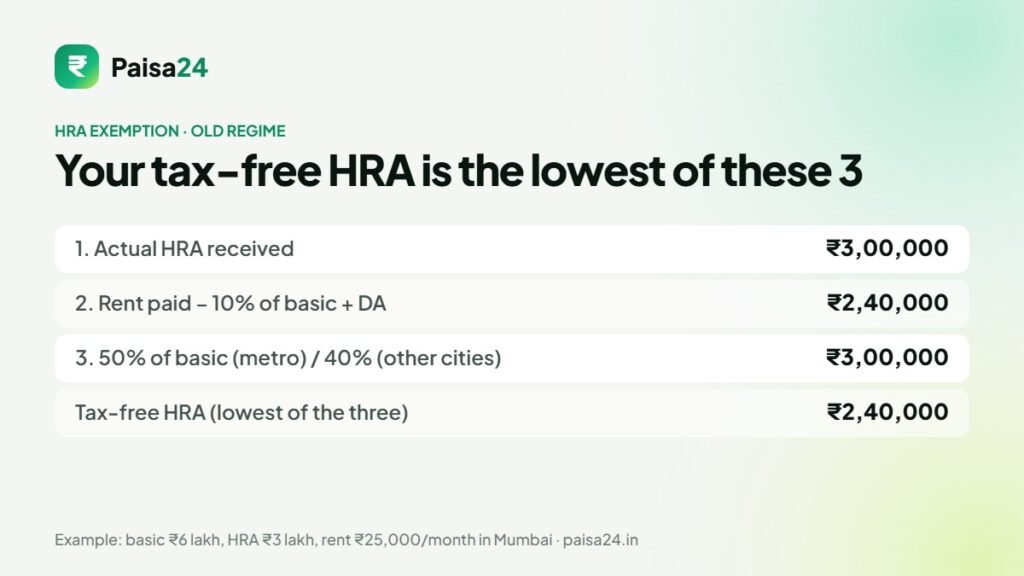
Say Anjali earns a basic salary of ₹50,000 a month (₹6 lakh a year), receives HRA of ₹25,000 a month (₹3 lakh a year) and pays rent of ₹25,000 a month in Mumbai.
| Rule | Amount |
|---|---|
| Actual HRA received | ₹3,00,000 |
| Rent paid − 10% of basic (₹3,00,000 − ₹60,000) | ₹2,40,000 |
| 50% of basic (Mumbai is a metro) | ₹3,00,000 |
| Tax-free HRA (lowest) | ₹2,40,000 |
So ₹2.4 lakh of her HRA is tax-free, and only ₹60,000 is taxed. At a 30% slab, that saves her about ₹74,900 a year including cess.
Free calculatorCalculate your HRA exemptionHow much of your rent allowance is tax-free.How to claim HRA exemption through your employer
- Declare your rent at the start of the year in your company’s investment declaration.
- Collect rent receipts every month, with the landlord’s name, address, amount, period and signature. Receipts above ₹5,000 in cash traditionally carry a revenue stamp.
- Get your landlord’s PAN if your rent is more than ₹1 lakh a year (about ₹8,333 a month).
- Keep the rent agreement and pay by bank transfer where possible, because it creates a clear record.
- Submit proofs before your employer’s deadline, usually January or February, so the correct TDS comes out.
Pro tip: Pay rent by bank transfer or UPI with a clear note such as “October rent”. A digital trail is the strongest proof if the tax department ever asks.
How to claim HRA exemption in your income tax return
Missed the employer deadline? Don’t worry. You can still claim the exemption yourself when you file your return on the income tax e-filing portal. First, enter the exempt HRA amount in the salary schedule. Then keep all receipts and the agreement safe, because the department may ask for them. As a result, any extra TDS your employer deducted comes back to you as a refund.
Can you claim HRA when paying rent to parents?
Yes, as long as the arrangement is genuine. Your parent must own the house, you must actually transfer the rent, and your parent must show it as rental income in their own return. For instance, if your parents are in a lower tax slab, the family as a whole can save tax. However, cash payments with no record often invite questions.
Mistakes to avoid when you claim HRA exemption
- Fake receipts: the department now matches landlord PANs and can check whether the landlord reports the income.
- Paying rent to your spouse: this is generally not accepted as a genuine arrangement.
- Claiming HRA and home loan in the same city carelessly: it is possible in some cases, but you must have a genuine reason, such as the owned house being far from your office.
- Choosing the new regime: HRA exemption simply does not exist there.
Is HRA worth choosing the old regime?
Often, HRA is what decides your regime. In Anjali’s case, ₹2.4 lakh of HRA plus ₹1.5 lakh of 80C and ₹25,000 of 80D gives ₹4.15 lakh of deductions. Even so, at most salaries that is below the break-even point. Therefore, always compare both regimes in our new vs old tax regime guide before you decide. You can also read the official rules on the Income Tax India website.
Frequently asked questions
How do I claim HRA exemption if I forgot to submit proofs?
You can claim it directly in your income tax return. Enter the exempt HRA in the salary section, keep your receipts and agreement, and you will get the extra TDS back as a refund.
Is landlord PAN mandatory to claim HRA exemption?
Yes, if your total rent for the year is more than ₹1 lakh. Below that, a PAN is not required.
Can I claim HRA in the new tax regime?
No. HRA exemption is available only in the old regime.
Which cities count as metro for HRA?
Delhi, Mumbai, Kolkata and Chennai. In these cities 50% of salary counts; elsewhere 40% applies.
Can I claim HRA if I pay rent to my parents?
Yes, if they own the house, you transfer rent genuinely, and they declare it as income in their own return.
Sources: Income Tax Department e-filing · Income Tax India. Last checked 21 October 2026. Figures are estimates for guidance, not tax or financial advice.
This guide is for information only and isn’t financial advice. Rates, fees and rules change — always confirm on the official website before you decide. Read our disclaimer.