How Much SIP for ₹1 Crore? Monthly Amount for 5 to 30 Years
To build ₹1 crore you need about ₹10,009 a month for 20 years at 12%. See the SIP needed for 5 to 30 years and with a yearly step-up.
On this page 11 sections
- 01Monthly SIP needed for ₹1 crore
- 02How ₹10,009 a month grows to ₹1 crore
- 03How long will your SIP take to reach ₹1 crore?
- 04₹1 crore faster with a yearly step-up
- 05Lump sum vs SIP for ₹1 crore
- 06Is ₹1 crore enough? The inflation check
- 07What if returns are lower?
- 08Steps to reach ₹1 crore
- 09Tax on your ₹1 crore
- 10Frequently asked questions
- 11Related guides and calculators
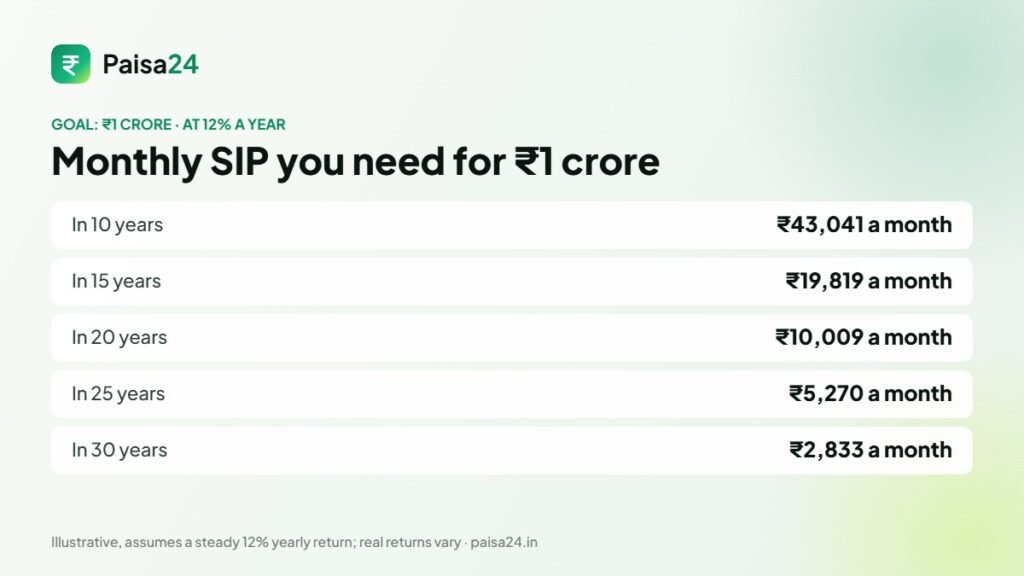
To build ₹1 crore with a SIP, you need to invest about ₹10,009 a month for 20 years at a 12% yearly return. Give it 25 years and ₹5,270 a month is enough. Want it in 10 years? You need about ₹43,041 a month. Below are the exact amounts for 5 to 30 years, what a yearly step-up does, and whether ₹1 crore is really enough.
Quick answer: SIP needed for ₹1 crore at 12%: ₹43,041 a month for 10 years, ₹19,819 for 15 years, ₹10,009 for 20 years, ₹5,270 for 25 years and ₹2,833 for 30 years.
Key takeaways
- ₹1 crore in 20 years at 12%: about ₹10,009 a month, of which only ₹24 lakh is your own money.
- Every 5 extra years roughly halves the monthly SIP you need.
- With a 10% yearly step-up, you can start 20 years out with just ₹5,028 a month.
- At 6% inflation, ₹1 crore in 20 years buys roughly what ₹31 lakh buys today, so plan your real goal, not a round number.
Monthly SIP needed for ₹1 crore
The table shows the monthly SIP that reaches ₹1 crore at three return levels. Use 10% if you want a cautious plan, 12% as a common long-term planning figure for diversified equity funds, and treat 14% as an optimistic case.
| Time to goal | At 10% | At 12% | At 14% |
|---|---|---|---|
| 5 years | ₹1,28,070 | ₹1,21,232 | ₹1,14,678 |
| 10 years | ₹48,414 | ₹43,041 | ₹38,155 |
| 15 years | ₹23,928 | ₹19,819 | ₹16,317 |
| 20 years | ₹13,060 | ₹10,009 | ₹7,597 |
| 25 years | ₹7,474 | ₹5,270 | ₹3,667 |
| 30 years | ₹4,387 | ₹2,833 | ₹1,800 |
How ₹10,009 a month grows to ₹1 crore
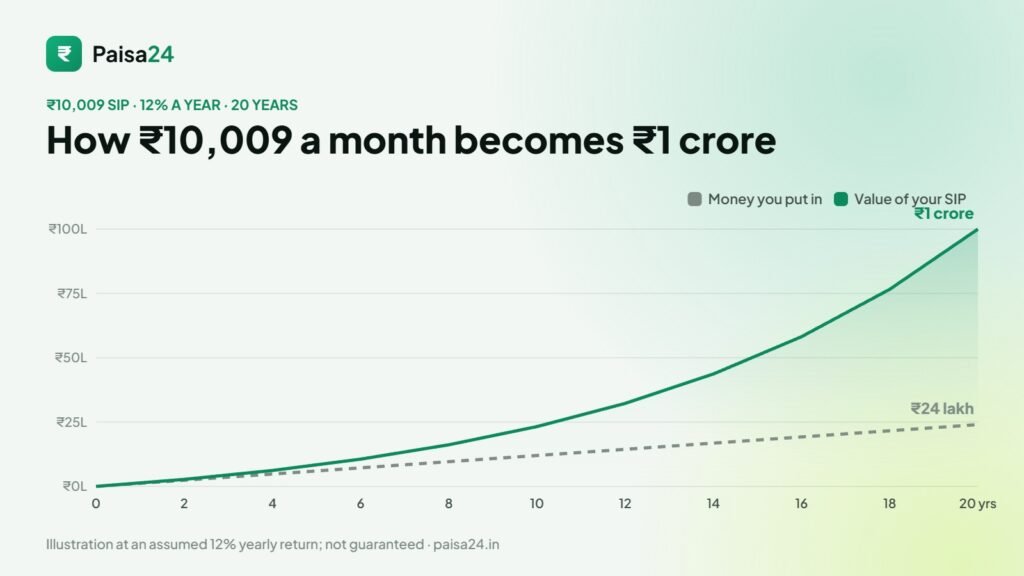
The magic of a long SIP is that most of the final value comes from returns, not your savings. Over 20 years, you put in ₹24 lakh and the market (at an assumed 12%) adds about ₹76 lakh.
| After | You have invested | SIP value at 12% |
|---|---|---|
| 4 years | ₹4.8 lakh | ₹6.19 lakh |
| 8 years | ₹9.61 lakh | ₹16.17 lakh |
| 12 years | ₹14.41 lakh | ₹32.25 lakh |
| 16 years | ₹19.22 lakh | ₹58.19 lakh |
| 20 years | ₹24.02 lakh | ₹1 crore |
Look at the last four years: the SIP value grows by more than ₹40 lakh, even though you add less than ₹5 lakh. That is why stopping a SIP early costs you the best years.
How long will your SIP take to reach ₹1 crore?
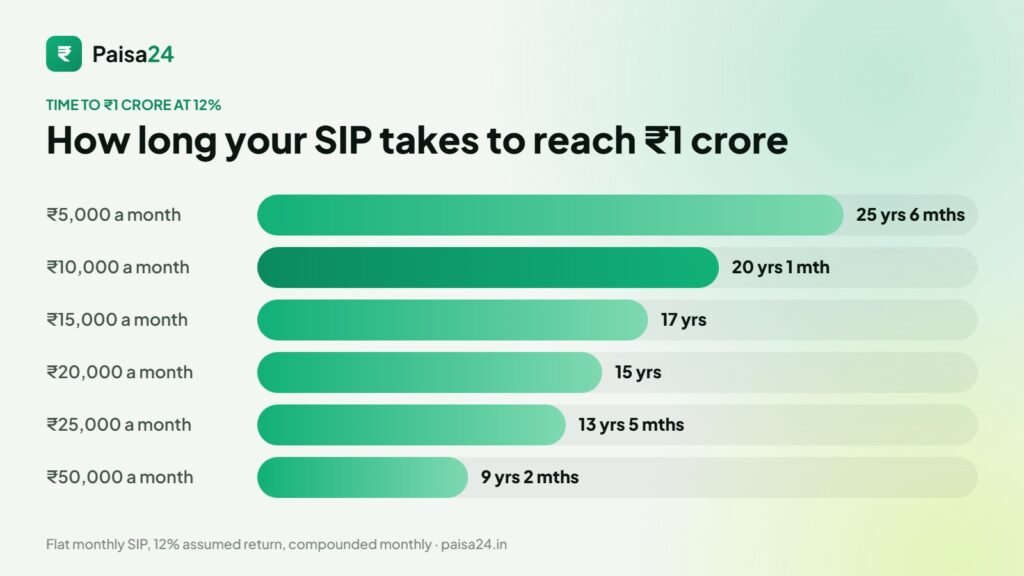
Already know how much you can invest? Here is how long each amount takes at 12%:
| Monthly SIP | Time to ₹1 crore | Total you invest |
|---|---|---|
| ₹3,000 | 29 years 7 months | ₹10.65 lakh |
| ₹5,000 | 25 years 6 months | ₹15.3 lakh |
| ₹10,000 | 20 years 1 month | ₹24.1 lakh |
| ₹15,000 | 17 years | ₹30.6 lakh |
| ₹20,000 | 15 years | ₹36 lakh |
| ₹25,000 | 13 years 5 months | ₹40.25 lakh |
| ₹50,000 | 9 years 2 months | ₹55 lakh |
See the detailed tables for a ₹5,000 SIP and a ₹10,000 SIP.
₹1 crore faster with a yearly step-up
Most people earn more each year. If you raise your SIP by 10% every year, the starting amount you need drops sharply (at 12%):
| Time to goal | Flat SIP needed | Starting SIP with 10% step-up |
|---|---|---|
| 10 years | ₹43,041 | ₹29,636 |
| 15 years | ₹19,819 | ₹11,516 |
| 20 years | ₹10,009 | ₹5,028 |
| 25 years | ₹5,270 | ₹2,339 |
So a 25-year-old who starts with ₹5,028 and raises it by 10% every year can reach ₹1 crore by 45. Most fund houses and apps let you set an automatic annual top-up when you register the SIP.
Lump sum vs SIP for ₹1 crore
If you already have savings, a one-time investment needs far less time to grow. Here is the lump sum you would need today to reach ₹1 crore at 12%:
| Time to goal | Lump sum needed today | Monthly SIP instead |
|---|---|---|
| 10 years | ₹32.2 lakh | ₹43,041 |
| 15 years | ₹18.3 lakh | ₹19,819 |
| 20 years | ₹10.4 lakh | ₹10,009 |
| 25 years | ₹5.9 lakh | ₹5,270 |
Many investors combine both: invest a bonus or savings as a lump sum (or spread it over 6 to 12 months) and run a monthly SIP alongside.
Is ₹1 crore enough? The inflation check
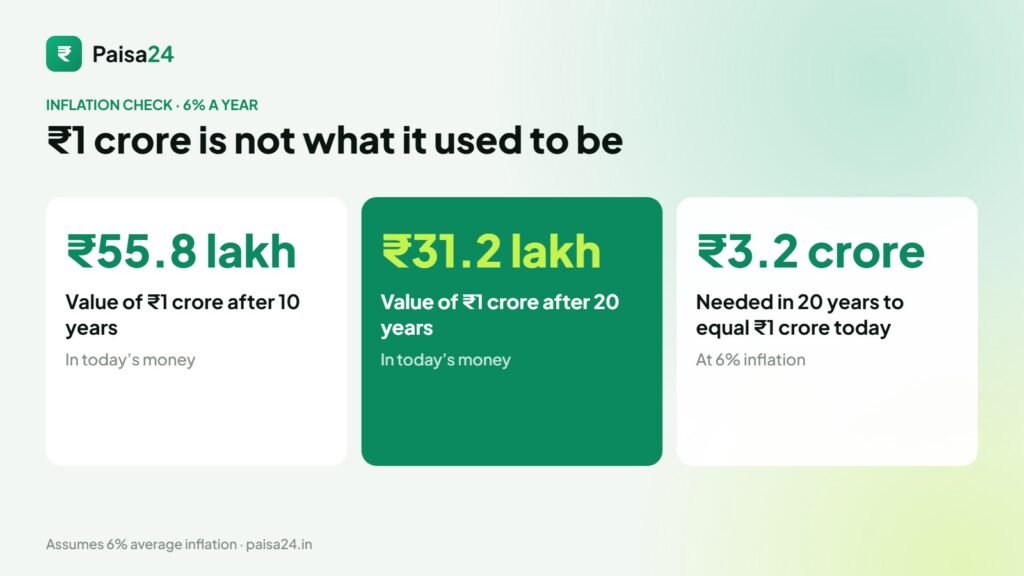
Prices rise every year. At 6% inflation, ₹1 crore in 20 years buys about what ₹31.2 lakh buys today. If you want the buying power of ₹1 crore today in 20 years, you need about ₹3.2 crore. For retirement, size the goal from your expenses: a common rule is 25 to 30 times your yearly expenses at retirement.
| Years from now | ₹1 crore is worth (today’s money) | Needed to match ₹1 crore today |
|---|---|---|
| 10 | ₹55.8 lakh | ₹1.79 crore |
| 15 | ₹41.7 lakh | ₹2.40 crore |
| 20 | ₹31.2 lakh | ₹3.21 crore |
| 25 | ₹23.3 lakh | ₹4.29 crore |
What if returns are lower?
Equity returns are not guaranteed. If you only want safe products such as PPF or FDs that earn around 7% to 8%, the monthly amount needed is much higher. At 8%, ₹1 crore needs about ₹54,299 a month for 10 years, ₹28,707 for 15 years and ₹16,865 for 20 years. That is why most long-term goals use at least some equity. Compare safe options in our PPF calculator.
Steps to reach ₹1 crore
- Pick your time frame and find the monthly SIP from the tables above.
- Start with what you can afford today and add a yearly step-up of 5% to 10%.
- Choose low-cost diversified funds, such as a Nifty 50 index fund or a flexi-cap fund, for goals 10+ years away. Direct plans cost less than regular plans.
- Keep going when markets fall. Lower prices mean your SIP buys more units.
- Move to safer options in the last 2 to 3 years, such as debt funds or FDs, so a market fall does not hit you right before you need the money.
Reality check: Returns are not guaranteed. Plan with 10% to 12% for equity, and treat anything higher as a bonus. Mutual fund investments are subject to market risks.
Tax on your ₹1 crore
When you redeem equity mutual funds held for more than 12 months, gains above ₹1.25 lakh a year are taxed at 12.5%. Gains on units held 12 months or less are taxed at 20%. Each SIP instalment has its own holding period. On a ₹1 crore corpus with ₹76 lakh of gains, redeeming everything in one year could cost around ₹9.7 lakh in tax including cess, so many investors withdraw gradually over several years to use the ₹1.25 lakh exemption each year.
How we calculated this: We used the standard SIP future-value formula with monthly compounding (rate ÷ 12) and the SIP paid at the start of each month. Step-up figures raise the SIP by 10% every 12 months. Inflation figures use 6% a year. These are illustrations, not guaranteed returns.
Frequently asked questions
How much SIP is needed for ₹1 crore in 10 years?
About ₹43,041 a month at 12%, or ₹48,414 at 10%.
How much SIP is needed for ₹1 crore in 15 years?
About ₹19,819 a month at 12%. With a 10% yearly step-up, you can start at about ₹11,516.
How much SIP is needed for ₹1 crore in 20 years?
About ₹10,009 a month at 12%. You invest about ₹24 lakh; the rest is growth.
Can a ₹5,000 SIP make ₹1 crore?
Yes, in about 25 and a half years at 12% with a flat SIP. With a 10% yearly step-up, it takes about 20 years.
How much lump sum do I need for ₹1 crore in 20 years?
About ₹10.4 lakh invested today at 12% a year.
Which funds are best for a ₹1 crore goal?
For goals more than 10 years away, low-cost diversified equity funds such as Nifty 50 index funds or flexi-cap funds are a common choice. Choose based on your risk comfort.
Is ₹1 crore enough for retirement?
Often not. At 6% inflation, ₹1 crore in 20 years is worth about ₹31 lakh today. Base your target on 25 to 30 times your yearly expenses.
Is the ₹1 crore taxed?
Equity fund gains held over 12 months are taxed at 12.5% above ₹1.25 lakh a year. Spreading redemptions across years can reduce the tax.
Related guides and calculators
- SIP of ₹10,000: returns table
- SIP of ₹5,000 for 10, 15 and 20 years
- SIP calculator with step-up
- FD vs SIP calculator
- 80C deductions list (ELSS, PPF and more)
Sources: AMFI · SEBI · Income Tax Department. Last checked 24 October 2026. Figures are estimates for guidance, not tax or financial advice. How we research and fact-check.
This guide is for information only and isn’t financial advice. Rates, fees and rules change — always confirm on the official website before you decide. Read our disclaimer.