How Much Term Insurance Do I Need? Exact Cover by Salary (2026)
Most Indians need term cover of 15–20× their income plus loans. Use the exact needs-based formula, see worked examples for ₹8 LPA and ₹12 LPA, 2026 premiums by age and claim settlement ratios.
On this page 11 sections
- 01Method 1: The 15–20× income rule (2-minute answer)
- 02Method 2: The needs-based formula (the accurate answer)
- 03Worked example 1: Rahul, 32, ₹12 LPA, home loan, one child
- 04Worked example 2: Priya, 28, ₹8 LPA, single, supports parents
- 05How much does term insurance cost in 2026?
- 06Till what age should the cover run?
- 07How to pick the insurer: check claim settlement
- 087 mistakes that leave families under-insured
- 09Tax benefits of term insurance
- 10Frequently asked questions
- 11Related guides and calculators
Short answer: most earning Indians need term insurance of 15 to 20 times their annual income, plus any loans they owe. On a ₹12 LPA salary that is about ₹1.8–2.4 crore. But the right number is personal — a 28-year-old with no kids and a 38-year-old with a home loan and two children need very different covers. This guide gives you the exact formula, two worked examples, a salary table, 2026 premiums by age, and the mistakes that leave families under-insured.
Key takeaways
- Quick rule: cover = 15–20× annual income + outstanding loans − existing investments.
- Exact method: fund your family’s yearly expenses for the years they depend on you, add loans and big goals, subtract assets, round up to the next ₹25 lakh.
- Cost: ₹1 crore cover for a 30-year-old non-smoker costs about ₹9,500 a year (till age 60). Individual life premiums carry nil GST since 22 September 2025.
- Buy young: the same cover costs roughly 2.3× more at 45 than at 25.
- Don’t count office group cover — it ends when your job does.
Method 1: The 15–20× income rule (2-minute answer)
Take your annual income, multiply by 15 if you are in your late 30s or 40s with fewer working years left, and by 20 if you are younger or have young children. Then add every loan you owe — home, car, personal — because your family should not inherit EMIs.
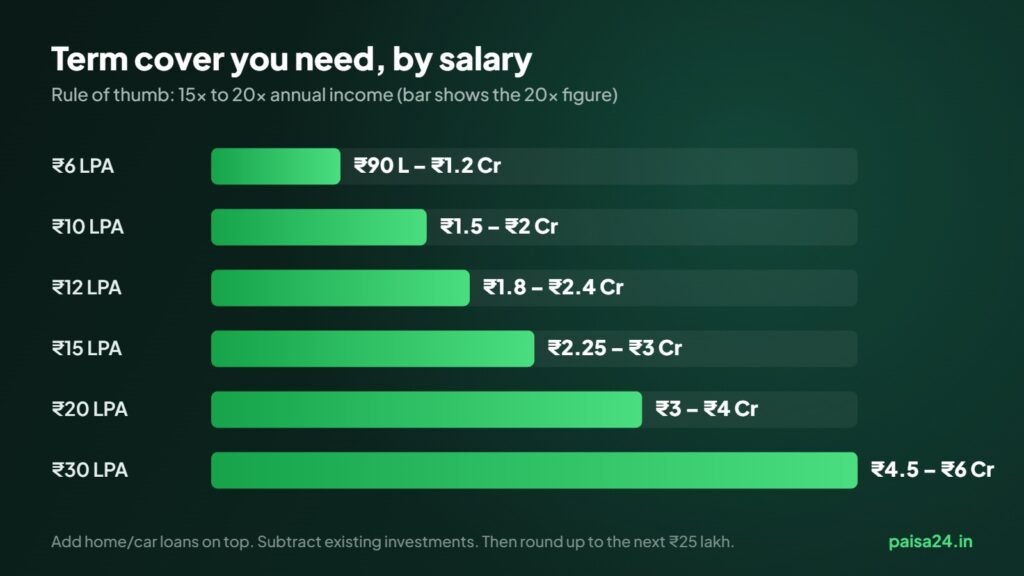
| Annual salary (CTC) | 15× income | 20× income | If you also have a ₹40 L home loan |
|---|---|---|---|
| ₹6 LPA | ₹90 lakh | ₹1.2 crore | ₹1.3 – 1.6 crore |
| ₹10 LPA | ₹1.5 crore | ₹2 crore | ₹1.9 – 2.4 crore |
| ₹12 LPA | ₹1.8 crore | ₹2.4 crore | ₹2.2 – 2.8 crore |
| ₹15 LPA | ₹2.25 crore | ₹3 crore | ₹2.65 – 3.4 crore |
| ₹20 LPA | ₹3 crore | ₹4 crore | ₹3.4 – 4.4 crore |
| ₹30 LPA | ₹4.5 crore | ₹6 crore | ₹4.9 – 6.4 crore |
The rule is a good sanity check, but it ignores how much your family actually spends, your savings, and your goals. For a number you can defend, use Method 2.
Method 2: The needs-based formula (the accurate answer)
Cover needed = (yearly family expenses × annuity factor) + outstanding loans + future goals − investments − existing personal life cover. Round up to the next ₹25 lakh.
The annuity factor answers: “How big a lump sum, invested safely, can pay ₹1 every year for N years while prices rise?” We assume the payout earns about 2% more than inflation each year (a conservative real return). That gives these factors:
| Years your family needs support | Annuity factor (2% real return) | Lump sum needed per ₹1 lakh of yearly expenses |
|---|---|---|
| 10 years | 8.98 | ₹8.98 lakh |
| 15 years | 12.85 | ₹12.85 lakh |
| 20 years | 16.35 | ₹16.35 lakh |
| 25 years | 19.52 | ₹19.52 lakh |
| 30 years | 22.40 | ₹22.40 lakh |
How long is “support”? Usually until your youngest child turns about 25, or until your spouse retires, whichever is later. If your parents depend on you, think about their life expectancy too.
Step-by-step: what to include and what to leave out
- Yearly expenses: household spending your family will still have without you — rent, groceries, school fees, utilities, parents’ medical costs. Leave out your own personal spending, commute and EMIs (you add loans separately).
- Loans: outstanding principal of home, car, education and personal loans. Check today’s balance in your loan app or use our EMI calculator.
- Goals: children’s higher education and wedding, a parent’s care fund — at today’s cost (the 2% real return already handles inflation).
- Subtract: FDs, mutual funds, EPF, PPF, stocks and any personal life cover you will keep. Don’t subtract your home or emergency fund, and don’t count employer group cover.
Worked example 1: Rahul, 32, ₹12 LPA, home loan, one child
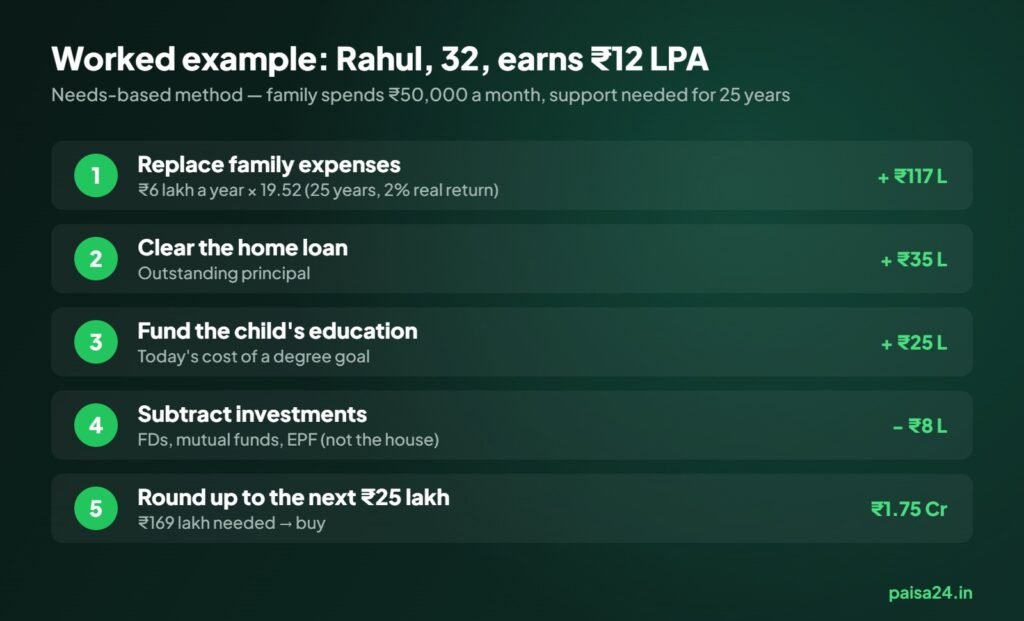
| Item | Amount |
|---|---|
| Family expenses: ₹50,000 a month = ₹6 lakh a year × 19.52 (25 years) | ₹117.1 lakh |
| Home loan outstanding | + ₹35 lakh |
| Child’s education goal (today’s cost) | + ₹25 lakh |
| Investments (FD + mutual funds + EPF) | − ₹8 lakh |
| Total need | ₹169.1 lakh |
| Buy (rounded up) | ₹1.75 crore |
Rahul’s employer gives a ₹30 lakh group cover. He ignores it, because if he changes jobs or gets laid off at 45, he would have to buy cover again at a much higher premium. Curious what a ₹12 LPA salary leaves in hand each month? See 12 LPA in-hand salary.
Worked example 2: Priya, 28, ₹8 LPA, single, supports parents
| Item | Amount |
|---|---|
| Parents’ expenses she covers: ₹30,000 a month = ₹3.6 lakh a year × 16.35 (20 years) | ₹58.9 lakh |
| Parents’ medical / care fund | + ₹10 lakh |
| No loans | ₹0 |
| Investments | − ₹3 lakh |
| Total need | ₹65.9 lakh |
| Buy (rounded up) | ₹75 lakh (or ₹1 crore to cover a future spouse and home loan) |
Single with no dependents at all? You may not need term insurance yet — but buying a modest cover at 25–28 locks in a low premium for 30+ years. Many people buy ₹1 crore early and add more later when they marry or take a home loan.
How much does term insurance cost in 2026?
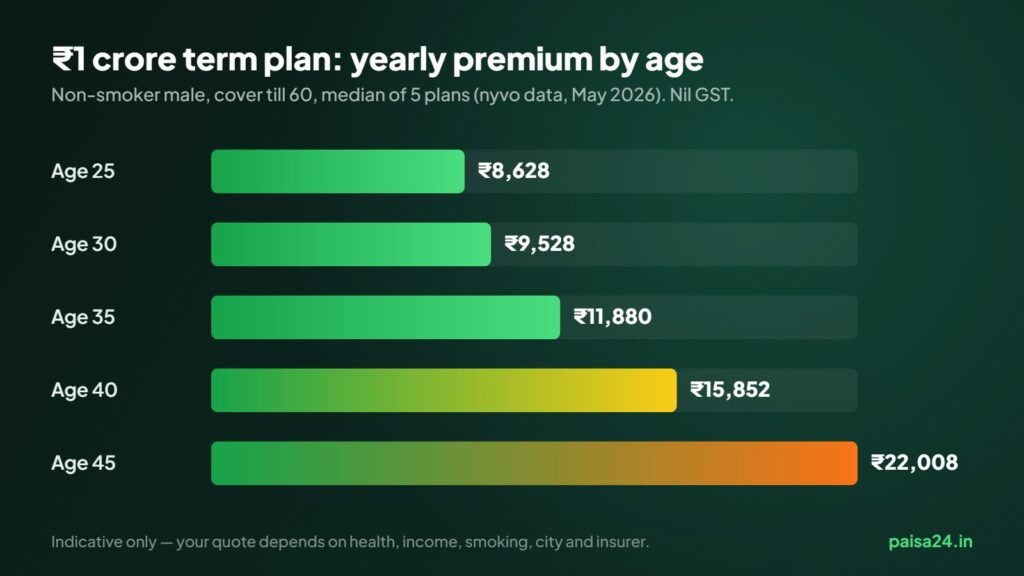
| Entry age | Male: yearly premium (median) | Female: yearly premium (median) | Male: monthly range across plans |
|---|---|---|---|
| 25 | ₹8,628 | ₹7,332 | ₹669 – ₹763 |
| 30 | ₹9,528 | ₹8,100 | ₹738 – ₹870 |
| 35 | ₹11,880 | ₹10,104 | ₹902 – ₹1,070 |
| 40 | ₹15,852 | ₹13,476 | ₹1,229 – ₹1,437 |
| 45 | ₹22,008 | ₹18,708 | ₹1,761 – ₹2,053 |
₹1 crore cover till age 60, non-smoker, median of five plans (nyvo premium data, May 2026). Smokers pay noticeably more. Your quote depends on health, income, city and medical tests. Because individual life insurance premiums have had nil GST since 22 September 2025, the quoted premium is now the full amount you pay.
Tip: covering ₹2 crore rarely costs twice as much as ₹1 crore — insurers usually give lower rates per lakh on higher slabs. Always compare a ₹1.5 crore and ₹2 crore quote before settling.
Till what age should the cover run?
- Till 60–65 for most people — roughly your retirement age, when your loans are paid off and your investments can take over.
- Avoid “till 85/99” plans by default. They cost much more, and by 70 most people no longer have dependents who need income replacement.
- Consider a longer term if you had children late or have a dependent with special needs.
How to pick the insurer: check claim settlement
A term plan is only as good as the claim your family can collect. Look at the individual death claim settlement ratio (by number of claims) for a few years, not just one.
| Insurer | Claim settlement ratio FY 2024-25 (by count) | Claims settled |
|---|---|---|
| Axis Max Life | 99.70% | 20,165 of 20,225 |
| HDFC Life | 99.68% | 19,666 of 19,729 |
| PNB MetLife | 99.57% | 5,615 of 5,639 |
| Tata AIA | 99.41% | 8,526 of 8,577 |
| ICICI Prudential | 99.31% | 12,319 of 12,405 |
| Bajaj Allianz Life | 99.29% | 13,994 of 14,094 |
| SBI Life | 98.34% | 44,205 of 44,949 |
| LIC | 97.59% | 8,48,145 of 8,69,086 |
Source: IRDAI Handbook on Indian Insurance Statistics 2024-25, as compiled by Artha Engine. All large insurers settle 97%+ of claims; honest disclosure on your proposal form matters more than a 0.3% difference.
7 mistakes that leave families under-insured
- Counting employer group cover. It disappears with your job.
- Ignoring loans. A ₹50 lakh home loan alone needs ₹50 lakh of cover. See EMI for a ₹50 lakh home loan.
- Buying LIC endowment or ULIP “for insurance”. ₹10,000 a year buys about ₹1 crore of term cover — but only ₹2–3 lakh of cover in many savings-cum-insurance plans.
- Hiding smoking, alcohol or medical history. This is the most common reason claims are rejected.
- Never reviewing cover. Revisit after marriage, a child, a home loan or a big raise.
- Not adding a nominee — or telling them. Register your spouse or parents as nominees and share the policy details.
- Waiting to “earn more first”. Every year you wait, the premium rises — and a new health issue can make you uninsurable.
Tax benefits of term insurance
Under the old tax regime, term premiums count towards the ₹1.5 lakh deduction limit for life insurance, PPF, ELSS and similar investments — see our 80C deductions list. The new tax regime gives no deduction for premiums. In both regimes, the death benefit paid to your nominee is generally tax-free. Not sure which regime suits you? Read new vs old tax regime.
Free calculatorFind your real take-home pay before choosing a premiumTurn your CTC into real monthly take-home after PF & tax.Frequently asked questions
How much term insurance do I need on a ₹10 lakh salary?
Roughly ₹1.5–2 crore (15–20× income), plus any outstanding loans. If your family spends ₹40,000 a month and needs support for 25 years, the needs-based method gives about ₹94 lakh for expenses alone, before loans and goals.
Is ₹1 crore term insurance enough?
For incomes up to about ₹6–7 LPA with no big loans, ₹1 crore is usually enough. Above that, or with a home loan and children, most families need ₹1.5–3 crore.
What is the cost of ₹1 crore term insurance for a 30-year-old?
About ₹9,500 a year for a non-smoking man and ₹8,100 for a woman, for cover till age 60 (May 2026 market medians). There is no GST on individual term premiums since 22 September 2025.
Should I count my company’s group insurance?
No. Group cover ends when you leave the job, and buying a new policy later costs more and depends on your health then. Treat it as a bonus.
Can I increase my term cover later?
Yes, by buying a second policy, or through a “life stage” option some plans offer on marriage, childbirth or a home loan. The new cover is priced at your age and health at that time.
Do housewives or non-earning spouses need term insurance?
Their work has real economic value (childcare, home management), but insurers usually limit cover for non-earning spouses based on the earning partner’s income. Check each insurer’s rules.
Related guides and calculators
- CTC vs in-hand salary
- 80C deductions list
- How much SIP for ₹1 crore?
- Prepay home loan: reduce EMI or tenure?
- EMI calculator
Sources: nyvo premium data (May 2026) · IRDAI handbook via Artha Engine · Nil GST on life insurance (Business Standard). Last checked 31 October 2026. Figures are estimates for guidance, not tax or financial advice. How we research and fact-check.
This guide is for information only and isn’t financial advice. Rates, fees and rules change — always confirm on the official website before you decide. Read our disclaimer.