UPI Charges After Diwali: Will You Pay 0.4%? NPCI Tells Supreme Court No
NPCI told the Supreme Court the new 0.4% UPI fee is paid only by merchants. Here is what stays free and what to do if a shop charges you extra.
On this page 7 sections
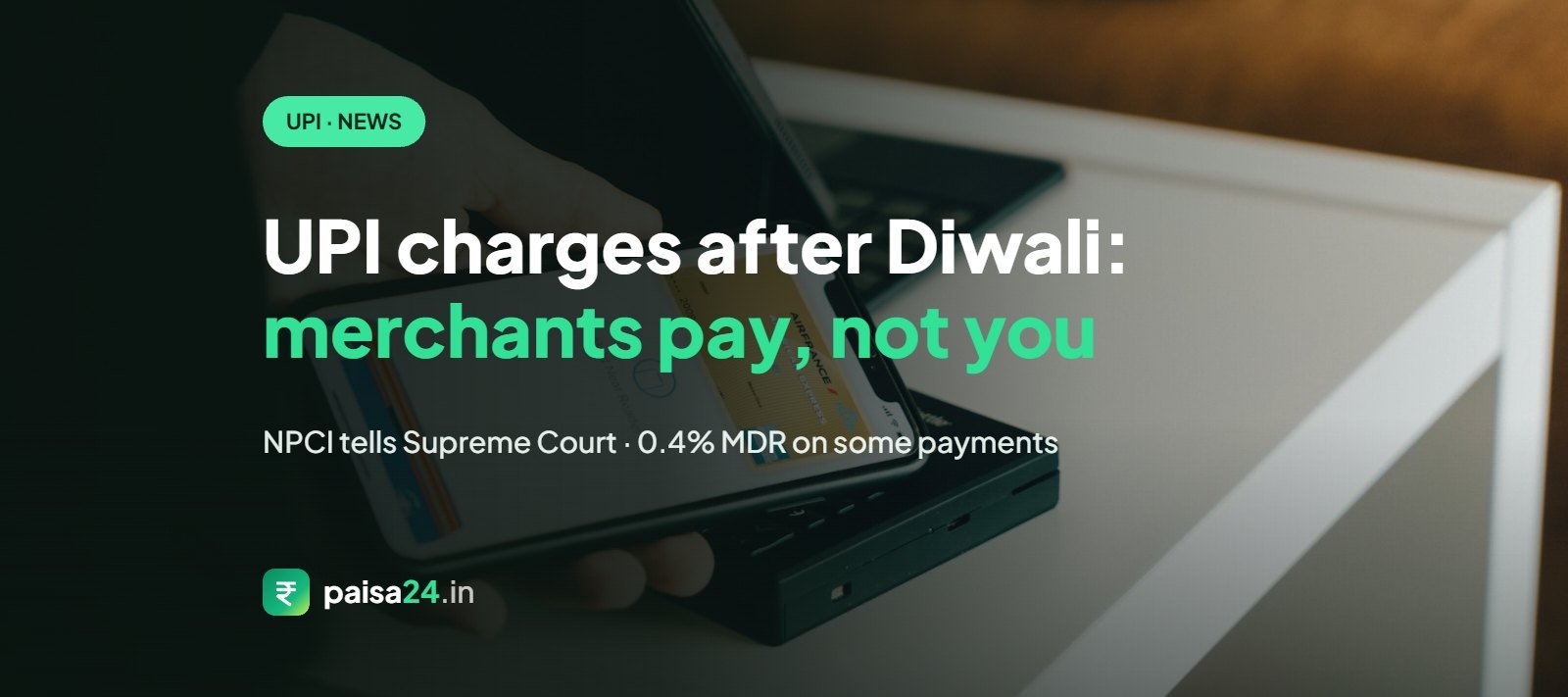
UPI charges after Diwali are the biggest payments story of the season, and most people are asking one thing: will Google Pay or PhonePe start cutting 0.4% from my account? The short answer is no. In a counter-affidavit filed in the Supreme Court on 3 November 2026, NPCI said the new fee is paid only by merchants, and no shop or UPI app can pass it on to you.
Last updated: 7 November 2026, IST
⚡ UPI charges after Diwali: key takeaways
- What: A merchant discount rate (MDR) of up to 0.4% on some shop payments above ₹2,000.
- Who pays: Only the merchant. Shops and UPI apps cannot add a surcharge or platform fee for you.
- Still free: All person-to-person transfers, shop payments up to ₹2,000, and small merchants receiving up to ₹1 lakh a month.
- When: Originally set for 15 October 2026, now postponed to a date after Diwali that NPCI has not yet announced.
- Court case: A petition in the Supreme Court is challenging the change. NPCI defended it on 3 November.
What NPCI told the Supreme Court about UPI charges
NPCI filed its reply on 3 November 2026, and MediaNama reported the details on 6 November. The main points are simple. First, the MDR is a commercial fee shared between banks and payment apps. It is not a tax or a government fee. Second, merchants and UPI apps are banned from passing it on to customers. NPCI called this rule binding, and said that breaking it could lead to compliance action or even loss of UPI membership.
NPCI also explained why it wants UPI charges after Diwali at all. With zero MDR, UPI has had a gap between what it costs to run and what it earns. That gap, NPCI argues, limits spending on fraud prevention, cyber safety and customer service. A Parliamentary Standing Committee report it cited says the government’s ₹2,000 crore support covers only about 11% of industry costs.
Which UPI payments will carry the 0.4% charge?
Most of your daily payments will not face UPI charges after Diwali. According to NPCI, about 70% of all UPI transactions are person-to-person, and about 96% of merchant payments are ₹2,000 or less. So the fee hits roughly 4% of merchant payments.
| Type of UPI payment | MDR (paid by merchant) |
|---|---|
| Sending money to a friend or family (P2P) | ₹0 |
| Shop payment up to ₹2,000 | ₹0 |
| Small merchant with up to ₹1 lakh UPI credits a month | ₹0 |
| UPI AutoPay mandates | ₹0 |
| Larger merchant, payment above ₹2,000 | Up to 0.4% |
| Payments of ₹75,000 and above | Capped at ₹300 |
| Railways, telecom, insurance, fuel | Flat ₹5 |
| Mutual funds, stockbrokers | 0.02%, capped at ₹300 |
The sector-specific numbers come from NPCI’s MDR framework as listed by PickMyWork. In other words, a ₹5,000 bill at a big electronics store could cost that store up to ₹20. You still pay ₹5,000.
Will shops quietly raise prices instead?
This is the real worry about UPI charges after Diwali, and it is the heart of the court challenge. The petitioner argues that merchants may simply raise prices for everyone to cover the fee. NPCI calls this concern “misconceived”, because the charge applies only to a small slice of payments above a threshold.
Still, keep an eye on your bills once UPI charges after Diwali begin. A separate “UPI charge” or “convenience fee” line on a shop bill is not allowed under NPCI’s rules. On the other hand, a general price increase is a business decision, and no rule stops it.
When do UPI charges start?
The original NPCI circular set 15 October 2026 as the start date. On 13 October, NPCI’s steering committee pushed it to “immediately post Diwali at a date to be notified separately”. As of 7 November, no final date has been announced. We will update this page as soon as it is.
Want these updates first? We post 60-second reels on Instagram at @paisa24_in, so follow us there.
What to do if a shop charges you extra for UPI
- Ask for a bill. Note the line that shows the extra UPI charge.
- Pay and take a screenshot of the UPI receipt with the merchant name and UPI ID.
- Complain inside your UPI app. Open the transaction and use “Help” or “Raise a dispute”.
- Escalate to NPCI through the UPI complaint section on the NPCI website if the app does not fix it.
- Go to the RBI Ombudsman if your bank does not reply within 30 days.
What this means for you
For most people, UPI charges after Diwali change nothing at the checkout. Your UPI transfers to friends stay free, and so does your daily tea, grocery and auto payment. Meanwhile, if you run a shop, check your monthly UPI credits. Staying under ₹1 lakh a month keeps you in the zero-MDR group, but staying above it for three months in a row moves you out.
Finally, if you pay big bills by credit card instead, remember those already carry merchant fees, and card rewards can still make them worth it. Read our guide on how to choose your first credit card, and see the other money rule changes in November 2026.
FAQs on UPI charges after Diwali
Will I pay any charge for sending money on UPI?
No. Person-to-person transfers stay free whatever the amount.
Will Google Pay or PhonePe deduct 0.4% from me?
No. NPCI says UPI apps cannot levy platform fees or pass the MDR to customers.
Is this a new tax?
No. NPCI describes MDR as a commercial fee shared between UPI participants, not a tax or government charge.
Sources: MediaNama, 6 November 2026; PickMyWork summary of NPCI’s MDR framework.
Keep exploring on Paisa24
🧮 Free calculators for this topic
- FD Calculator — maturity and interest on any FD
- SIP Calculator — see what your monthly SIP grows to
- EMI Calculator — EMI for home, car and personal loans
📚 Related reads
This guide is for information only and isn’t financial advice. Rates, fees and rules change — always confirm on the official website before you decide. Read our disclaimer.