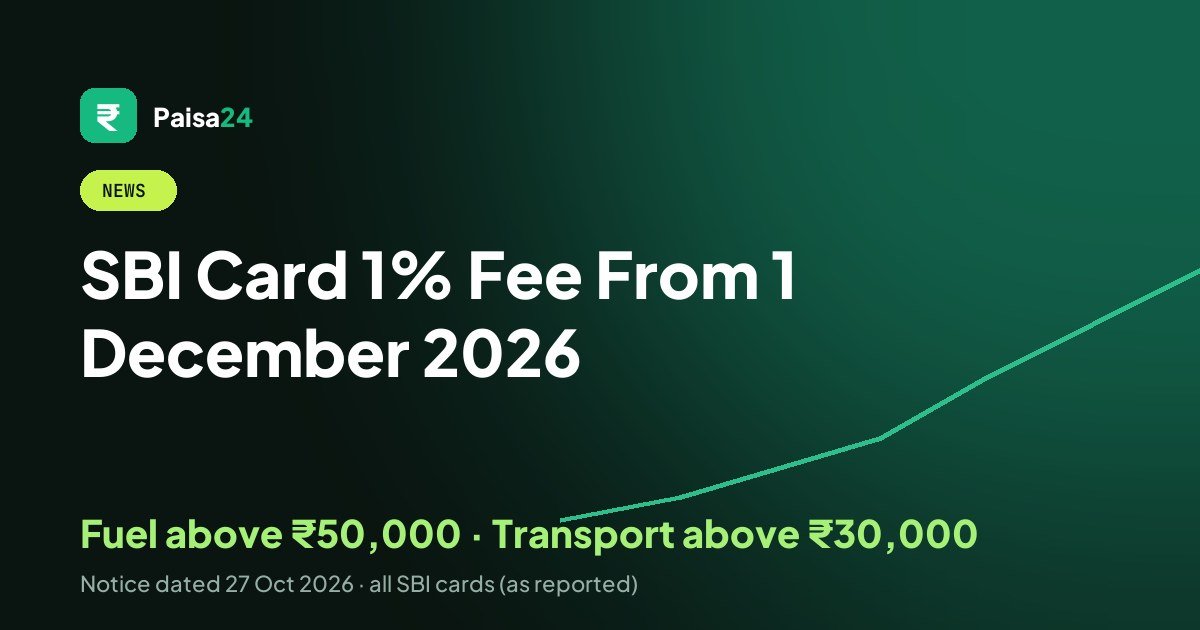
SBI Card 1% Fee From 1 December 2026: Fuel Above ₹50,000, Transport Above ₹30,000
SBI Card will charge a 1% fee on big fuel and transport spends from 1 December 2026. See who pays, worked examples and how to avoid the fee.
On this page 8 sections
Quick answer: the SBI Card 1% fee starts on 1 December 2026. You will pay 1% on any single transport payment above ₹30,000, and 1% on your entire fuel spend if it crosses ₹50,000 in one billing cycle. Reports say it applies to all SBI credit cards, including Flipkart SBI Card and BPCL SBI Card OCTANE.
The change comes from an SBI Card customer notice dated 27 October 2026, as reported by Outlook Money and Goodreturns. The fee is small on paper. However, it can sting if you put your fuel or large travel payments on the card every month, so it is worth checking now.
Key takeaways
- Effective date: 1 December 2026.
- Transport: 1% on each single payment above ₹30,000.
- Fuel: 1% on the whole fuel spend once it goes above ₹50,000 in a billing cycle, not just on the excess.
- The fee is charged in addition to applicable taxes, according to the reports.
- Fuel spend of exactly ₹50,000 or less in a cycle attracts no fee.
What the SBI Card 1% fee covers
| Transport | Fuel | |
|---|---|---|
| Fee | 1% | 1% |
| When it applies | A single transaction above ₹30,000 | Total fuel spend above ₹50,000 in one billing cycle |
| Charged on | That transaction | The entire fuel spend of the cycle |
| Merchant category codes (MCC) | 4111, 4784, 4131 | 5172, 5541, 5542, 5983 |
| What the codes cover | Local and suburban commuter transport, toll and bridge fees, bus transport | Fuel dealers and petroleum products |
SBI Card 1% fee examples: how much will you pay?
Fuel (per billing cycle)
| Fuel spend in the cycle | Fee |
|---|---|
| ₹40,000 | ₹0 |
| ₹50,000 | ₹0 |
| ₹50,001 | about ₹500 |
| ₹55,000 | ₹550 |
| ₹60,000 | ₹600 |
| ₹75,000 | ₹750 |
Look at the jump. Spending ₹50,000 costs nothing in fees, but ₹50,001 costs about ₹500, because the 1% applies to the full amount. So the last rupee can cost you ₹500.
Transport (per transaction)
| Payment | Fee |
|---|---|
| ₹25,000 | ₹0 |
| ₹30,000 | ₹0 |
| ₹35,000 | ₹350 |
| ₹50,000 | ₹500 |
| Two payments of ₹20,000 each | ₹0 (each is below the limit) |
The transport threshold applies to each payment separately, not to your combined transport spend. Fees exclude taxes, so your actual charge can be slightly higher.
Who is affected by the SBI Card 1% fee?
- Heavy fuel users. If you spend more than ₹50,000 a cycle on fuel, for example for a business vehicle or a taxi, you will pay.
- Big commuter and toll payments. Large one-time payments for passenger transport or tolls above ₹30,000 attract the fee.
- Co-branded cardholders. Reports say Flipkart SBI Card and BPCL SBI Card OCTANE are included, so rewards-focused users should recheck their math.
- Normal users. If your fuel spend stays under ₹50,000 and you rarely make single transport payments above ₹30,000, nothing changes for you.
How to avoid the SBI Card 1% fee
- Track your billing cycle, not the calendar month. The ₹50,000 fuel limit counts per billing cycle. Check your cycle dates in the SBI Card app.
- Stay at or under ₹50,000 on fuel. Pay for the extra fuel with another card, UPI or a debit card. Remember that one rupee above the limit costs 1% of everything.
- Keep single transport payments at or below ₹30,000 where you can. For example, two payments of ₹20,000 each do not attract the fee, according to the reports. However, check your card terms, because the issuer decides how it treats split payments.
- Compare your rewards with the fee. If your card gives rewards on fuel, a 1% fee may cancel part of them. Do the math before you keep paying by card.
- Never skip the bill. If you carry a balance, interest makes small fees worse. Read what happens when you miss a credit card bill.
What is not clear yet
- We did not see the SBI Card notice itself. The details above come from reports that cite it. Please check the notice on the SBI Card website or in your app.
- Reports differ slightly in how they describe the merchant codes, so your exact transaction may be classified differently.
- It is not clear how the fee interacts with any fuel surcharge waiver your card may offer. Check your card’s terms.
Other card changes to watch from 1 December
SBI Card is not the only issuer revising charges. Other banks have also announced card and account fee changes around December. We will cover the full list in our next monthly money rule changes roundup. Meanwhile, if you are choosing a card, read how to choose your first credit card. Also, a healthy score helps you get better cards, so see how to improve your CIBIL score.
Frequently asked questions
When does the SBI Card 1% fee start?
It starts on 1 December 2026, according to the SBI Card notice dated 27 October 2026 as reported by Outlook Money and Goodreturns.
Does the SBI Card 1% fee apply to all fuel payments?
No. It applies only when your eligible fuel spend in a billing cycle goes above ₹50,000. Then it is charged on the total fuel spend.
Is the 1% charged only on the amount above ₹50,000?
No. If your fuel spend crosses ₹50,000, the 1% applies to the entire amount. For example, ₹60,000 of fuel costs ₹600.
Does the transport fee apply to my total monthly transport spend?
No. The ₹30,000 limit applies to each single transaction. Two separate payments of ₹20,000 each do not attract the fee, according to the reports.
Which SBI cards are affected?
Reports say all SBI credit cards are included, with Flipkart SBI Card and BPCL SBI Card OCTANE named as examples. Check your own card’s terms to be sure.
Are taxes charged on top of the fee?
Yes. The reports say the fee is “excluding applicable taxes”, so GST can add to the final amount.
Sources: Outlook Money and Goodreturns, both citing SBI Card’s customer notice of 27 October 2026. Fees and terms can change, so confirm with SBI Card. This article is for general information and is not financial advice.
This guide is for information only and isn’t financial advice. Rates, fees and rules change — always confirm on the official website before you decide. Read our disclaimer.