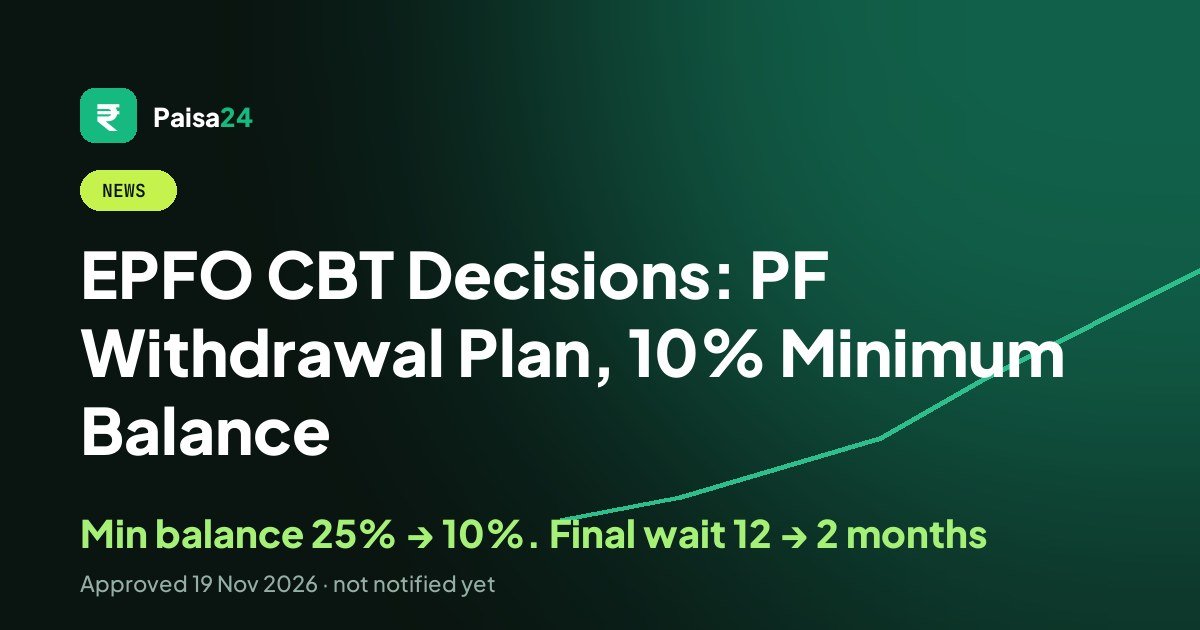
EPFO CBT Decisions (19 Nov 2026): PF Withdrawal Plan, 10% Minimum Balance, 2-Month Wait
EPFO's board approved a monthly PF payout plan for retirees, cut the minimum balance from 25% to 10% and the final-withdrawal wait to 2 months. What changes for you, and what is still pending.
On this page 9 sections
- 01Key takeaways
- 02The 7 EPFO CBT decisions at a glance
- 031. EPFO CBT decisions on the Systematic Withdrawal Plan (SWP)
- 042. EPFO CBT decisions on the minimum balance: 25% to 10%
- 053. EPFO CBT decisions on the final withdrawal wait
- 064 to 7: the other EPFO CBT decisions
- 07What is still unclear about the EPFO CBT decisions
- 08What to do now after the EPFO CBT decisions
- 09Frequently asked questions
Quick answer: the EPFO CBT decisions of 19 November 2026 cover seven proposals approved by the Central Board of Trustees. The three that matter most to members: a Systematic Withdrawal Plan (SWP) so retirees can take their PF as monthly, quarterly or half-yearly payouts; the minimum balance cut from 25% to 10%; and the wait for final PF withdrawal cut from 12 months to 2 months. These still need the Labour Ministry to notify the amendments before you can use them.
Key takeaways
- Labour Minister Mansukh Mandaviya chaired the 240th CBT meeting in New Delhi on Thursday, 19 November 2026.
- The SWP is voluntary. Your unwithdrawn balance keeps earning interest at the prevailing EPF rate.
- You will be able to access up to 90% of your eligible balance in partial withdrawals instead of 75%.
- Nothing is live yet. The Labour Ministry must first approve and notify the EPF Scheme amendments.
- The board announced no decision on the ₹1,000 minimum EPS pension. We had covered that review in what the meeting could decide.
The 7 EPFO CBT decisions at a glance
| # | Decision | What it means |
|---|---|---|
| 1 | Systematic Withdrawal Plan (SWP) | Retirees can take PF savings in periodic instalments instead of one lump sum |
| 2 | Direct voluntary contributions | UAN-linked way to contribute directly, plus third-party micro-contributions such as customer tips, independent of employer payroll |
| 3 | Minimum balance and waiting period | Minimum balance 25% → 10%. Wait for final withdrawal 12 months → 2 months |
| 4 | EDLI exemption relief | Six-month window for eligible establishments to renew expired exemptions, with relief from contributions, interest and penal damages for the verified period |
| 5 | Investment in AIFs | In-principle approval to invest up to 3% of fresh accretions in eligible Alternative Investment Funds, initially via government-backed entities |
| 6 | Exemption surrenders and cancellations | 27 establishments surrendered and 4 were cancelled, moving about ₹5,996 crore of PF savings of 1,44,437 members to EPFO |
| 7 | CITES 2.0 progress report | Auto-processed claims rose from 39% to 71%, rejections fell from 23% to 7.82%, average settlement time fell from 11.15 to 2.57 days |
1. EPFO CBT decisions on the Systematic Withdrawal Plan (SWP)
The biggest of the EPFO CBT decisions is the SWP. Today, most retirees withdraw the full PF corpus in one go. Under the SWP, a retiring member can instead receive payouts monthly, quarterly or half-yearly. The rest of the money stays invested, and interest keeps accruing at the prevailing EPF rate on the shrinking remaining balance.
- It is entirely voluntary. Nobody is forced to opt in.
- The ministry may also extend the option to eligible family members or beneficiaries.
- However, if a member dies during the payout period, the nominee or dependant can withdraw the remaining balance or continue the periodic payments.
- The ministry estimates about 6.32 lakh members aged above 55 with PF balances above ₹5 lakh will benefit first.
- It is separate from the EPS pension. It lets you draw down your own EPF savings and does not replace the monthly pension.
How long could a payout last? (illustration)
EPFO has not announced payout limits or the interest rate for this plan. So the table below is our own illustration, and it assumes 8% a year interest on the remaining balance. It is not an official figure.
| PF corpus | Monthly payout | Interest earned per month (start) | How long it lasts |
|---|---|---|---|
| ₹10 lakh | ₹10,000 | ₹6,667 | about 13.8 years |
| ₹10 lakh | ₹15,000 | ₹6,667 | about 7.4 years |
| ₹20 lakh | ₹20,000 | ₹13,333 | about 13.8 years |
| ₹20 lakh | ₹25,000 | ₹13,333 | about 9.6 years |
As a rule of thumb, if your monthly payout is less than the monthly interest, the corpus does not run out. However, anything above that eats into your principal. Compare this with an FD or other options before deciding.
2. EPFO CBT decisions on the minimum balance: 25% to 10%
Among the EPFO CBT decisions, this one affects the most members. Earlier, 25% of your PF had to stay untouched. The board has cut that to 10%. In practice, you can access up to 90% of the eligible balance for permitted needs such as housing, medical treatment and education, instead of 75%.
| Eligible PF balance | Accessible at 25% minimum | Accessible at 10% minimum |
|---|---|---|
| ₹5 lakh | ₹3.75 lakh | ₹4.5 lakh |
| ₹10 lakh | ₹7.5 lakh | ₹9 lakh |
| ₹20 lakh | ₹15 lakh | ₹18 lakh |
This assumes the whole balance qualifies. Also, the 12-month minimum service condition for partial withdrawals stays as it was.
Think before you withdraw. The minimum balance existed so your money keeps compounding at EPF’s rate. A bigger withdrawal limit gives flexibility, but it is not a reason to spend, because early withdrawals shrink the retirement corpus you will rely on later.
3. EPFO CBT decisions on the final withdrawal wait
Another of the EPFO CBT decisions helps people between jobs. If you are unemployed, you will be able to claim the final PF settlement after 2 months instead of 12. This reverses the 12-month wait that the board introduced in October 2025.
It applies to the final PF withdrawal. However, the board did not announce a change to the 36-month waiting period for withdrawing EPS pension accumulations.
4 to 7: the other EPFO CBT decisions
- Direct voluntary contributions: the ministry says it is taking up a matching Income Tax Act amendment with the Finance Ministry, so the tax treatment is not yet settled.
- EDLI relief: mainly for employers who maintained group insurance but could not complete exemption formalities.
- AIF investment: the approval is in-principle only, and it stays within the existing investment ceiling. For background, see our earlier explainer on EPFO investing in startups through AIFs.
- Claims processing: the CITES 2.0 numbers suggest fewer rejected claims. To benefit, keep your details correct, as explained in how to fix name, DOB and job records online.
What is still unclear about the EPFO CBT decisions
- When it starts. The Labour Ministry must first approve and notify the EPF Scheme amendments, and it has given no date.
- Tax on SWP. It is an open question whether instalments and the interest on the retained balance will get the same treatment as eligible lump-sum withdrawals.
- Payout limits and the interest rate under the SWP are not yet public.
- Minimum EPS pension. The board announced no change to the ₹1,000 figure at this meeting.
What to do now after the EPFO CBT decisions
- Do nothing in a hurry. Nothing is live, so wait for the official notification on the EPFO website.
- Check your UAN, KYC and bank details on the member portal so future claims are not rejected.
- Do not rush to withdraw just because the limit rises, because your PF earns a government-set rate with compounding.
- If you retire soon, compare an SWP with other income options once the rules and tax treatment are clear. Meanwhile, pensioners should keep their proof of life current, as covered in Jeevan Pramaan online.
Frequently asked questions
Do the EPFO CBT decisions let me withdraw 90% of my PF now?
Not yet. The board approved the cut from 25% to 10%, but the cut takes effect only after the ministry notifies the scheme amendment.
Is the SWP compulsory?
No. It is voluntary. You can still withdraw your PF in one go.
Does the SWP replace my EPS pension?
No. EPS pension is a separate scheme with its own rules. The SWP only lets you draw down your own EPF savings in instalments.
Was the minimum pension hiked?
No. The board announced no decision on the ₹1,000 minimum EPS pension at the 19 November meeting.
When can I claim my PF after losing my job?
Under the approved change, the wait for final settlement drops to 2 months once the ministry notifies the rule. Until then, the current rule applies.
Will SWP payouts be taxed?
Not clarified yet, because the government is still working with the Finance Ministry on the tax treatment.
Sources: reports on the 240th CBT meeting by Upstox and Deccan Herald, quoting the Labour Ministry. Details can change once the ministry notifies the amendments. This article is for general information and is not financial or legal advice.
This guide is for information only and isn’t financial advice. Rates, fees and rules change — always confirm on the official website before you decide. Read our disclaimer.