RBI Money Transfer Rules 2026: Send ₹50,000 Cash via NEFT Without a Bank Account
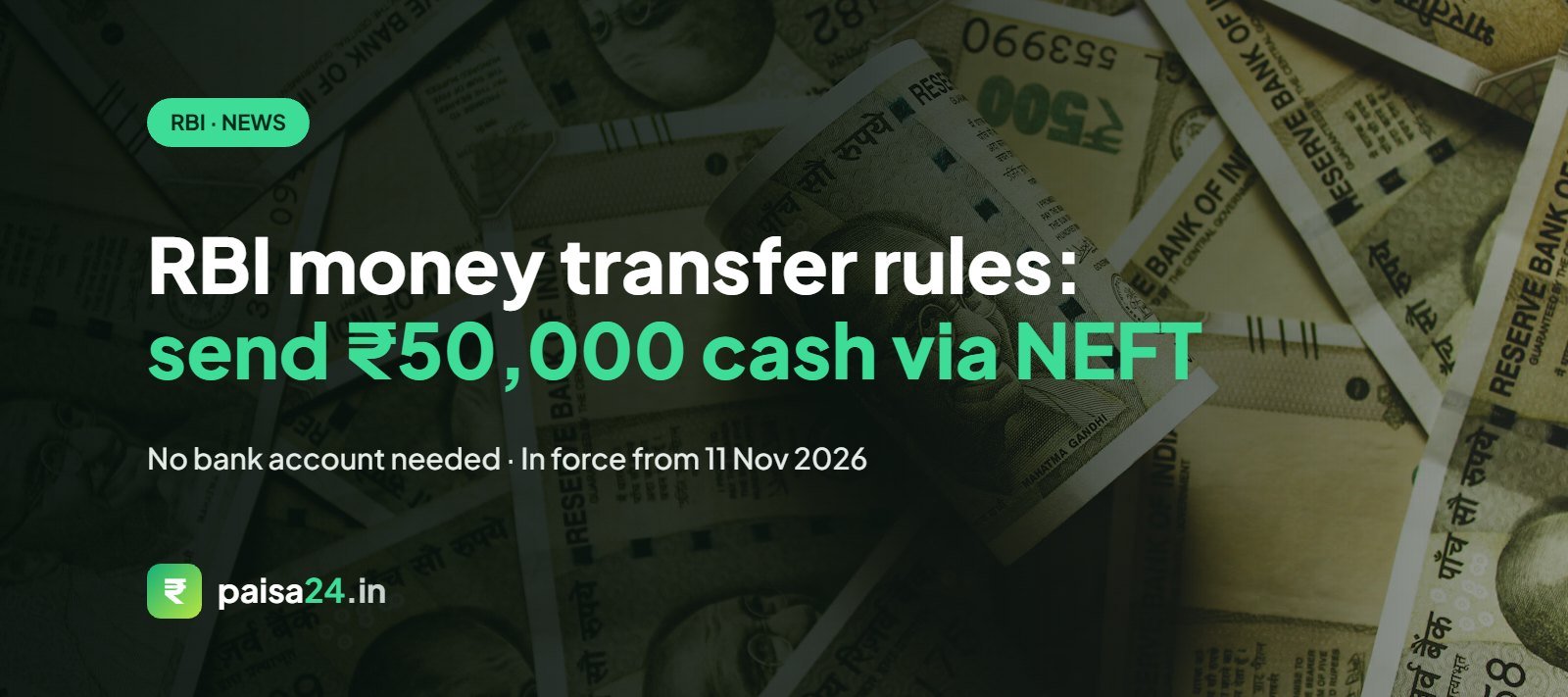
RBI has consolidated its domestic money transfer rules. Walk-in customers can now send up to ₹50,000 in cash through NEFT at a bank branch. Here are the limits, documents and charges.
On this page 9 sections
- 01What the new RBI money transfer rules say
- 02Limits under the RBI money transfer rules (2026)
- 03How to send ₹50,000 cash through NEFT at a branch
- 04Cash pay-out: sending money to someone without a bank account
- 05Safety checks every bank must follow
- 06Charges and complaints
- 07Who benefits from the new RBI money transfer rules
- 08What to do now
- 09FAQs on the RBI money transfer rules
RBI money transfer rules just got a clean rewrite. On 11 November 2026, the Reserve Bank of India brought every rule on small cash remittances under one rule book, the Reserve Bank of India (Domestic Money Transfer) Directions, 2026. As a result, anyone can now walk into a bank branch and send up to ₹50,000 in cash to a bank account through NEFT, even without an account at that bank. This matters most for migrant workers, small traders and families who still send money home in cash.
Last updated: 12 November 2026, IST
⚡ RBI money transfer rules: key takeaways
- What changed: RBI merged its 2011 and 2024 circulars into one set of Domestic Money Transfer Directions, 2026.
- Branch cash via NEFT: Walk-in customers can send up to ₹50,000 in cash to any bank account.
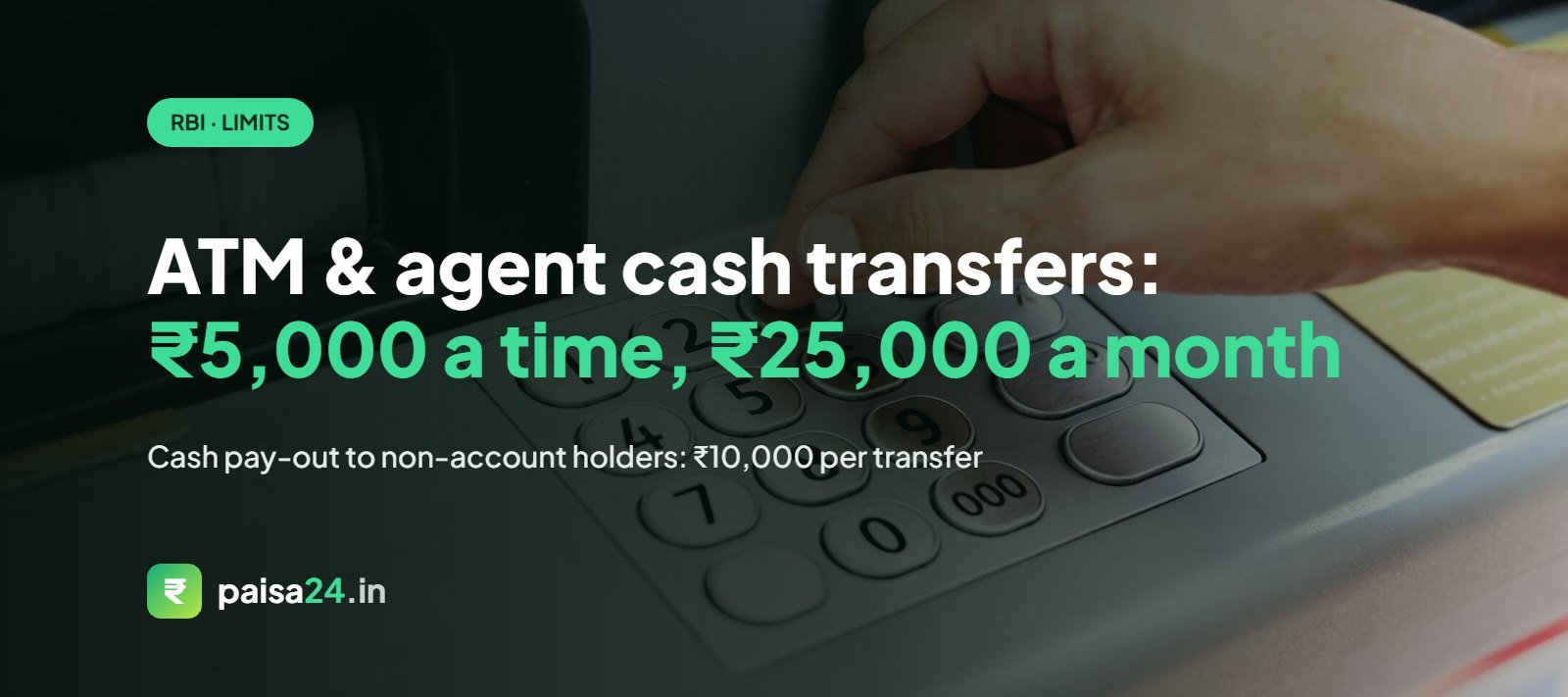
- ATM and agent route: ₹5,000 per transaction, capped at ₹25,000 a month per sender.
- Cash pay-out: Account holders can send up to ₹10,000 per transfer (₹25,000 a month) to someone with no bank account.
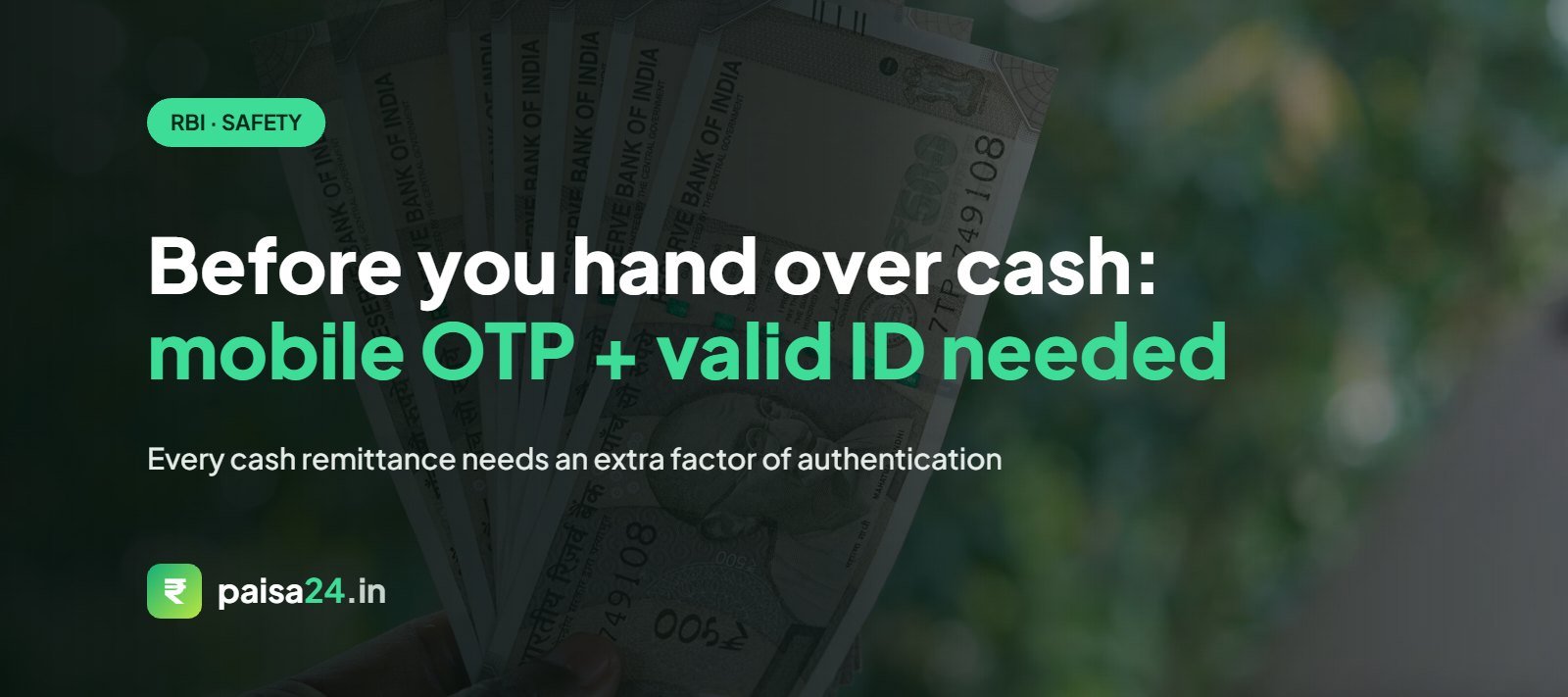
- Safety: Verified mobile number, a self-certified ID and an extra authentication step are now mandatory.
What the new RBI money transfer rules say
The new directions do not invent fresh limits. Instead, they keep the limits from the existing framework and put them in one place. According to Business Standard, the rule book replaces RBI’s 5 October 2011 circular and its 24 July 2024 review. In other words, banks now have a single reference, and customers get clearer rights.
The rules apply to scheduled commercial banks, regional rural banks, urban co-operative banks, state co-operative banks and district central co-operative banks. They also cover authorised payment system operators, to the extent they offer domestic money transfer services. However, card-to-card transfers are outside this framework and stay under their own rules.
Limits under the RBI money transfer rules (2026)
Here is every limit in one table. Notably, the branch NEFT route has the highest cap, while ATMs and business correspondents (BC agents) carry tighter limits because they are harder to monitor.
| Route | Who can use it | Per transaction | Monthly cap |
|---|---|---|---|
| Cash at branch → NEFT to any bank account | Walk-in customer, with or without an account | ₹50,000 | Not specified |
| Cash via ATM / BC agent → bank account | Walk-in customer (sender) | ₹5,000 | ₹25,000 per sender |
| Account → cash pay-out to a person without a bank account | Bank account holder | ₹10,000 | ₹25,000 per beneficiary |
Source: RBI Domestic Money Transfer Directions, 2026, as reported by Business Today and Business Standard.
How to send ₹50,000 cash through NEFT at a branch
The process is simple. Even so, carry the right documents, because the bank must verify you before it accepts cash.
- Visit any branch of a bank that offers the walk-in NEFT facility.
- Fill in the NEFT form with the receiver’s name, account number and IFSC code.
- Give your mobile number. The bank will verify it, usually with an OTP.
- Show and self-certify an officially valid document (OVD), such as Aadhaar, passport, voter ID or driving licence.
- Complete the additional factor of authentication (AFA) the bank asks for.
- Hand over the cash and keep the receipt with the UTR number. You can use it to track the transfer.
Because transfers must be real-time or near real-time, the money should reach the receiver within the NEFT settlement cycle. Also, the NEFT message will carry your details and a flag showing it was a cash-based remittance.
Cash pay-out: sending money to someone without a bank account
The second big piece of the RBI money transfer rules is the cash pay-out service. Here, you send money from your own bank account, and the receiver collects cash at an ATM, a BC agent or another authorised channel. For example, a worker in Delhi can send money to a parent in a village who has no account.
- The limit is ₹10,000 per transaction.
- Each beneficiary can receive up to ₹25,000 a month through this route.
- Your bank must record the beneficiary’s name and address.
Safety checks every bank must follow
Cash remittances are a common route for mule accounts and fraud. Therefore, RBI has made several checks compulsory:
- Verified mobile and ID: Sender registration needs a verified mobile number and a self-certified OVD, as per RBI’s KYC Directions, 2025.
- Extra authentication: Every transaction needs an additional factor of authentication.
- Credit alerts: Account holders must get alerts when money lands through these facilities.
- Velocity checks: Banks must watch for sudden spikes in credits to an account and report suspicious transactions.
If someone asks you to “receive and forward” cash deposits for a commission, refuse. That is how mule accounts work, and your account can be frozen. Read our guide on how to get money back after a UPI fraud to see how quickly these cases escalate.
Charges and complaints
RBI has not fixed a fee. Instead, banks and payment companies may charge a “reasonable” amount, so costs will vary. Ask for the charge before you pay. If something goes wrong, first complain to the bank. After that, you can escalate under the RBI Integrated Ombudsman Scheme, 2026.
Who benefits from the new RBI money transfer rules
- Migrant workers who earn in cash and support family in another state.
- Small shopkeepers who pay suppliers in other cities.
- Families sending fees or emergency money to students.
- Senior citizens who are not comfortable with UPI apps.
Meanwhile, if you already have a bank account, UPI and IMPS remain faster and usually free. Also check our explainer on UPI charges after Diwali to see which payments stay free.
What to do now
- Save the receiver’s account number and IFSC carefully. NEFT cannot be reversed easily.
- Always collect the receipt and UTR number.
- Never deposit cash for strangers or “job” offers.
- Planning savings with that money instead? Compare returns with our FD calculator.
FAQs on the RBI money transfer rules
Can I send ₹50,000 cash without a bank account?
Yes. Under the new rules, a walk-in customer can deposit up to ₹50,000 in cash at a bank branch and send it to any bank account via NEFT.
What documents do I need?
You need a verified mobile number and a self-certified officially valid document, such as Aadhaar, passport, voter ID or driving licence.
What is the limit at ATMs and BC agents?
₹5,000 per transaction, with a monthly cap of ₹25,000 per sender.
When did the new RBI money transfer rules start?
The Domestic Money Transfer Directions, 2026 took effect on 11 November 2026.
Are there charges?
Yes, banks may levy reasonable charges. RBI has not set a uniform fee, so ask your bank first.
Sources: Business Standard, Business Today, The Logical Indian. Paisa24 explains rules in plain language; check with your bank for its exact process and charges.
Keep exploring on Paisa24
🧮 Free calculators for this topic
- FD Calculator — maturity and interest on any FD
- SIP Calculator — see what your monthly SIP grows to
- EMI Calculator — EMI for home, car and personal loans
📚 Related reads
This guide is for information only and isn’t financial advice. Rates, fees and rules change — always confirm on the official website before you decide. Read our disclaimer.