Gratuity Calculation Formula 2026: New Rules Can Raise Your Payout by 66%
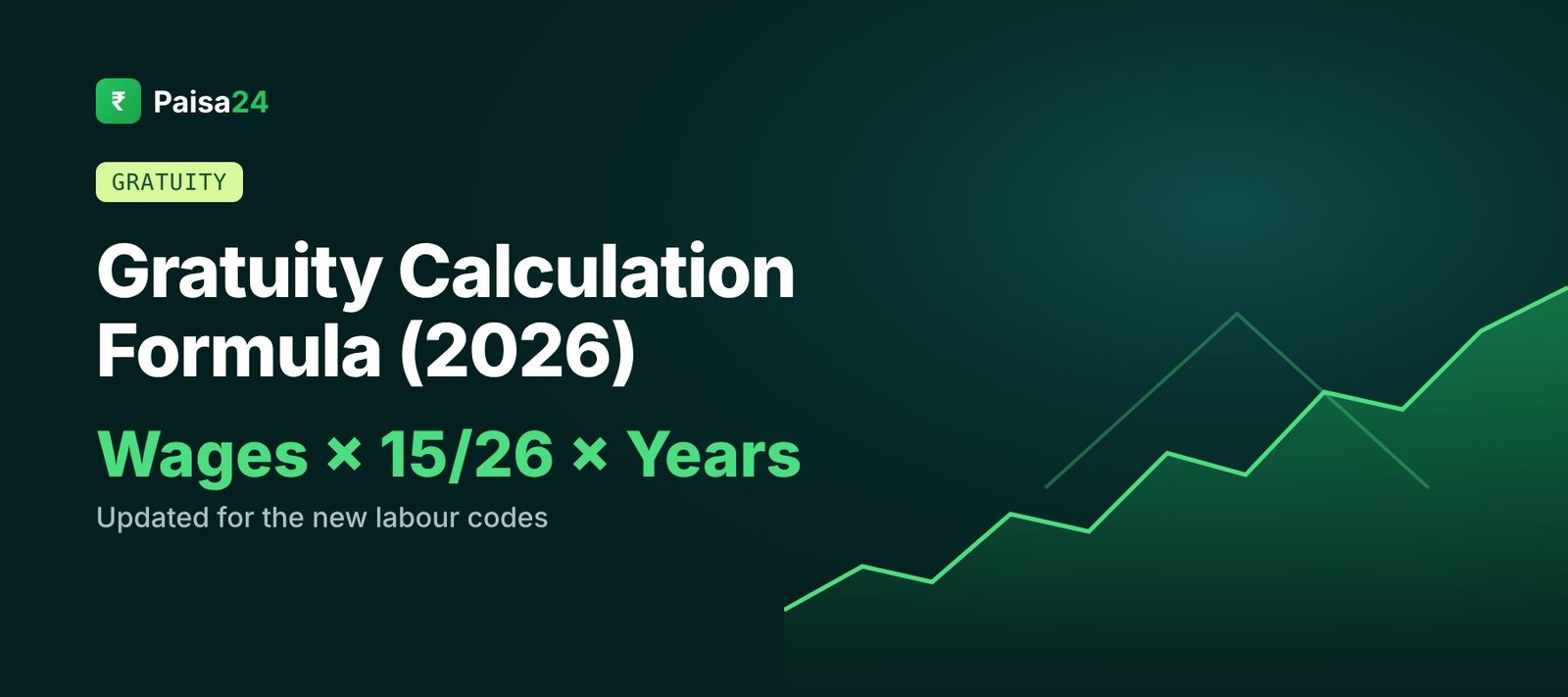
Gratuity = last drawn wages × 15/26 × completed years of service. See how the new labour codes change gratuity in 2026, worked examples, eligibility and tax rules.
On this page 9 sections
The gratuity calculation formula is simple: Gratuity = last drawn wages × 15/26 × completed years of service, where wages mean basic pay plus dearness allowance. So if your last basic plus DA is ₹50,000 and you served 10 years, your gratuity is about ₹2,88,462. The new labour codes, in force since 21 November 2025, have changed who qualifies and how “wages” are counted, which raises gratuity for most private employees. Here is the formula, the 2026 rules, worked examples and how gratuity is taxed.
Quick answer: Gratuity = (Basic + DA) × 15 ÷ 26 × years of service. Permanent employees need 5 years of continuous service; fixed-term employees now qualify after 1 year. Gratuity is capped at ₹20 lakh, and that amount is tax-free for private employees.
Key takeaways
- Formula: last drawn basic + DA × 15/26 × completed years. The 26 stands for working days in a month, and 15 days’ wages are paid per year.
- A part year of more than six months counts as a full year, so 9 years 7 months counts as 10 years.
- Under the new labour codes, wages for gratuity must be at least 50% of your total pay, which raises gratuity for anyone with a low basic.
- Fixed-term (contract) employees are now eligible after one year instead of five.
- Gratuity is capped at ₹20 lakh and is tax-free up to that limit for private employees covered by the law.
Gratuity formula explained
For employees covered by the gratuity law (establishments with 10 or more employees), the formula is:
Gratuity = Last drawn wages × 15/26 × Number of completed years of service
- Last drawn wages: your basic pay plus dearness allowance (DA) for the last month. Under the new codes, if basic + DA is less than 50% of your total pay, the shortfall is added back (see below).
- 15/26: you earn 15 days’ wages for every year of service, and a month is treated as 26 working days.
- Years of service: completed years, with any part year above six months rounded up. 7 years 5 months counts as 7 years; 7 years 7 months counts as 8.
Gratuity calculation examples
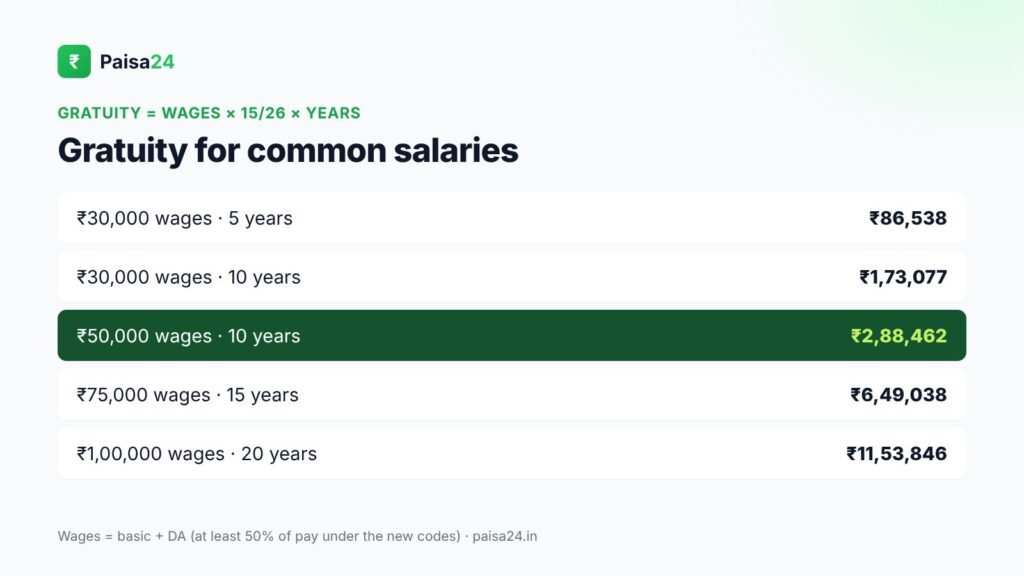
Example 1: Priya’s last basic + DA is ₹50,000 and she worked 9 years 8 months. Her service rounds up to 10 years. Gratuity = 50,000 × 15/26 × 10 = ₹2,88,462.
Example 2: Rahul earns basic + DA of ₹30,000 and resigns after exactly 5 years. Gratuity = 30,000 × 15/26 × 5 = ₹86,538.
Example 3 (fixed-term): Ayesha is on a two-year fixed-term contract with wages of ₹40,000. She is eligible after one year. For one completed year, gratuity = 40,000 × 15/26 × 1 = ₹23,077.
| Last wages (basic + DA) | 5 years | 10 years | 15 years | 20 years | 25 years |
|---|---|---|---|---|---|
| ₹20,000 | ₹57,692 | ₹1,15,385 | ₹1,73,077 | ₹2,30,769 | ₹2,88,462 |
| ₹30,000 | ₹86,538 | ₹1,73,077 | ₹2,59,615 | ₹3,46,154 | ₹4,32,692 |
| ₹50,000 | ₹1,44,231 | ₹2,88,462 | ₹4,32,692 | ₹5,76,923 | ₹7,21,154 |
| ₹75,000 | ₹2,16,346 | ₹4,32,692 | ₹6,49,038 | ₹8,65,385 | ₹10,81,731 |
| ₹1,00,000 | ₹2,88,462 | ₹5,76,923 | ₹8,65,385 | ₹11,53,846 | ₹14,42,308 |
| ₹1,50,000 | ₹4,32,692 | ₹8,65,385 | ₹12,98,077 | ₹17,30,769 | ₹20,00,000* |
What changed under the new labour codes (2026)
The Code on Social Security, 2020 replaced the Payment of Gratuity Act, 1972 when the four labour codes were notified on 21 November 2025. Most employers are applying the changes in full payrolls from the 2026-27 financial year. Three changes matter for your gratuity:
1. The 50% wage rule
“Wages” now include basic pay, DA and retaining allowance, and must be at least 50% of your total remuneration. If HRA, special allowance and other excluded parts add up to more than 50%, the excess is added back to wages. Companies that kept basic at 30% to 40% of pay must now calculate gratuity on a higher amount.
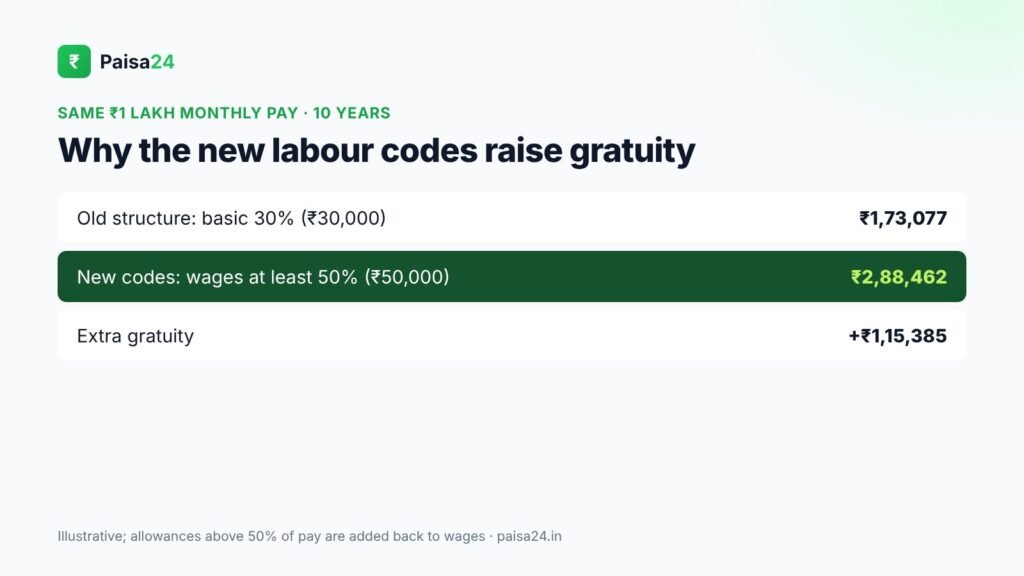
Take someone earning ₹1 lakh a month with basic at ₹30,000. After 10 years, the old calculation gives ₹1,73,077. Under the 50% rule, wages become ₹50,000 and gratuity rises to ₹2,88,462, about ₹1.15 lakh more. The flip side: a higher wage base also increases PF, which can slightly reduce monthly take-home. See how this affects pay in CTC vs in-hand salary.
2. Fixed-term employees qualify after one year
Fixed-term employees, hired directly by the employer for a set period, now get gratuity on a pro-rata basis after one year of continuous service, instead of five. Someone on an 11-month contract is still not eligible.
3. Last drawn wages for all service
For service spread across the old and new law, gratuity is worked out on the last wages you draw at exit, under the new code’s definition.
Who is eligible for gratuity?
- Permanent employees: at least 5 years of continuous service with the same employer. Courts and labour departments generally treat 4 years and 240 working days in the fifth year as meeting this.
- Fixed-term employees: at least 1 year of continuous service.
- Death or disability: the 5-year condition does not apply. Gratuity is paid to the nominee or legal heir based on actual service.
- Events that trigger payment: retirement, resignation, superannuation, termination (other than for proven misconduct), death or disablement.
Notice period counts. Your service ends on your last working day, so serving the notice period can push you past the 5-year mark or the 6-month rounding point. Check your dates before you resign.
Gratuity if your employer is not covered
If your employer has fewer than 10 employees and is not covered by the law, it may still pay gratuity voluntarily. The usual formula is then last drawn salary × 15/30 × completed years, where salary is the average of the last 10 months and part years are ignored. For example, an average salary of ₹50,000 for 10 years gives 50,000 × 15/30 × 10 = ₹2,50,000.
How gratuity is taxed
| Employee type | Tax-free gratuity |
|---|---|
| Central and state government employees | Fully tax-free |
| Private employees covered by the law | Least of: actual gratuity, ₹20 lakh, or 15/26 × last wages × years |
| Private employees not covered | Least of: actual gratuity, ₹20 lakh, or half a month’s average salary × completed years |
Any amount above the exempt limit is added to your salary and taxed at your slab rate in the year you receive it. For example, if you receive ₹22 lakh, ₹2 lakh is taxable. Check your slab in our income tax slabs guide.
When will you get your gratuity?
- Apply in writing to your employer (usually through HR) when gratuity becomes payable, ideally within 30 days of your exit.
- The employer must work out the amount and pay it within 30 days of it becoming due.
- Late payment carries interest at the government-notified simple interest rate.
- If the employer refuses, you can approach the controlling authority (the labour department) under the code.
- Keep your nomination updated, so your family can claim it without delay.
Gratuity is part of your CTC. Employers typically set aside 4.81% of basic every year for it, which is why a 12 LPA salary shows about ₹28,860 a year as gratuity.
Frequently asked questions
What is the formula for gratuity?
Gratuity = last drawn basic + DA × 15/26 × completed years of service, for employees covered by the law. Part years above six months count as a full year.
How much gratuity will I get for 5 years with ₹30,000 basic?
About ₹86,538 (30,000 × 15/26 × 5).
Is gratuity paid after 4 years and 8 months?
Under the rounding rule, a part year above six months counts as a full year, and 4 years with 240 working days in the fifth year is widely accepted as 5 years of service. Many employers pay in this case, but check your company’s policy.
What is the gratuity rule for fixed-term employees in 2026?
Fixed-term employees are eligible after one year of continuous service under the new labour codes, on a pro-rata basis.
What is the maximum gratuity limit?
₹20 lakh for private employees. Any amount above the tax-free limit is taxed at your slab rate.
Is gratuity part of CTC?
Yes, most companies include about 4.81% of basic as gratuity in CTC, but you receive it only when you leave after becoming eligible.
Related guides and calculators
- Gratuity calculator
- CTC vs in-hand salary explained
- 12 LPA in-hand salary
- 15 LPA in-hand salary
- Income tax slabs FY 2026-27
- Salary calculator
Sources: Ministry of Labour and Employment · Income Tax Department · Gazette of India. Last checked 30 October 2026. Figures are estimates for guidance, not tax or financial advice. How we research and fact-check.
This guide is for information only and isn’t financial advice. Rates, fees and rules change — always confirm on the official website before you decide. Read our disclaimer.