Gold Jewellery Price Calculation: How Jewellers Bill 22K Gold (Making Charges, GST & Hallmark)
Wedding season is here and gold is volatile. Learn the exact gold jewellery price calculation jewellers use, with a worked 10 g bill, making-charge comparison, GST and hallmark checks.
On this page 10 sections
- 01Step 1 of gold jewellery price calculation: pick the right rate
- 02Step 2: Use the net weight, not the gross weight
- 03Step 3: Add making charges
- 04Step 4: Add 3% GST
- 05Worked example: gold jewellery price calculation for a 10 g 22K chain
- 06How making charges change your gold jewellery price calculation
- 07Hallmark checks before you pay
- 08Exchanging or selling old gold
- 097 tips to cut your gold jewellery price calculation
- 10FAQs on gold jewellery price calculation
Gold jewellery price calculation looks confusing on a jeweller’s bill, but it follows one simple formula. You pay for the gold, the making charges and GST, and that’s it. Gold rate searches in India are running far ahead of every other money topic this week, because the wedding season has started and prices have swung sharply after Dhanteras. So before you buy, here is exactly how the bill is built, with a real example at today’s rate.
Last updated: 12 November 2026, IST
⚡ Gold jewellery price calculation: quick formula
- Final price = (Gold rate per gram × net weight) + making charges + 3% GST on the total.
- Use the 22K rate for most jewellery, not the 24K rate quoted in headlines.
- Making charges usually range from about 5% to 18% or more, and they are negotiable.
- Hallmark: Every piece must carry the BIS logo, purity grade and a 6-digit HUID.
- Today (12 Nov 2026, Delhi): 22K about ₹12,835/g, 24K about ₹13,995/g, before making and GST.
Step 1 of gold jewellery price calculation: pick the right rate
Headlines usually quote the 24-carat rate. However, 24K gold is too soft for most jewellery, so necklaces, bangles and chains are usually 22K. Similarly, diamond and lightweight pieces often use 18K. Therefore, always ask the jeweller which purity you are buying and which rate they used.
| Purity | Hallmark grade | Gold content | Typical use | Indicative rate, Delhi (12 Nov 2026) |
|---|---|---|---|---|
| 24K | 24K999 | 99.9% | Coins, bars | ₹13,995/g |
| 22K | 22K916 | 91.6% | Most traditional jewellery | ₹12,835/g |
| 18K | 18K750 | 75% | Diamond and studded jewellery | ₹10,500/g |
| 14K | 14K585 | 58.5% | Light daily-wear pieces | Ask jeweller |
Rates from Upstox, indicative and before making charges and GST. Prices change daily and differ slightly between cities.
Step 2: Use the net weight, not the gross weight
In any gold jewellery price calculation, the gold rate applies only to the gold. If a piece has stones, kundan or enamel, the jeweller should subtract that weight first. For example, a 12 g necklace with 2 g of stones has 10 g of gold. Otherwise, you end up paying the gold rate for stones. So check that the bill shows gross weight, stone weight and net weight separately.
Step 3: Add making charges
Making charges are the biggest variable in a gold jewellery price calculation. They pay for design and labour. Jewellers quote them in two ways:
- As a percentage of the gold value, for example 12%.
- As a flat rate per gram, for example ₹800 per gram.
Machine-made chains usually carry lower charges, while intricate handmade designs cost more. In South India, some jewellers also add a “wastage” charge, which works the same way. In any case, ask for the making charge in rupees before billing, because it is the most negotiable part of the price.
Step 4: Add 3% GST
Tax is the last step of the gold jewellery price calculation. When you buy finished jewellery, GST is 3% on the full value, which includes making charges. Meanwhile, the 5% rate applies only to job work, when a goldsmith makes or repairs jewellery from gold you supply. If you want to check the tax maths quickly, use our GST calculator.
Worked example: gold jewellery price calculation for a 10 g 22K chain
Here is a full bill at today’s Delhi 22K rate of ₹12,835 per gram, with a 12% making charge.
| Item | Calculation | Amount |
|---|---|---|
| Gold value | ₹12,835 × 10 g | ₹1,28,350 |
| Making charges (12%) | 12% of ₹1,28,350 | ₹15,402 |
| Subtotal | Gold + making | ₹1,43,752 |
| GST (3%) | 3% of ₹1,43,752 | ₹4,313 |
| Final price | ₹1,48,065 |
How making charges change your gold jewellery price calculation
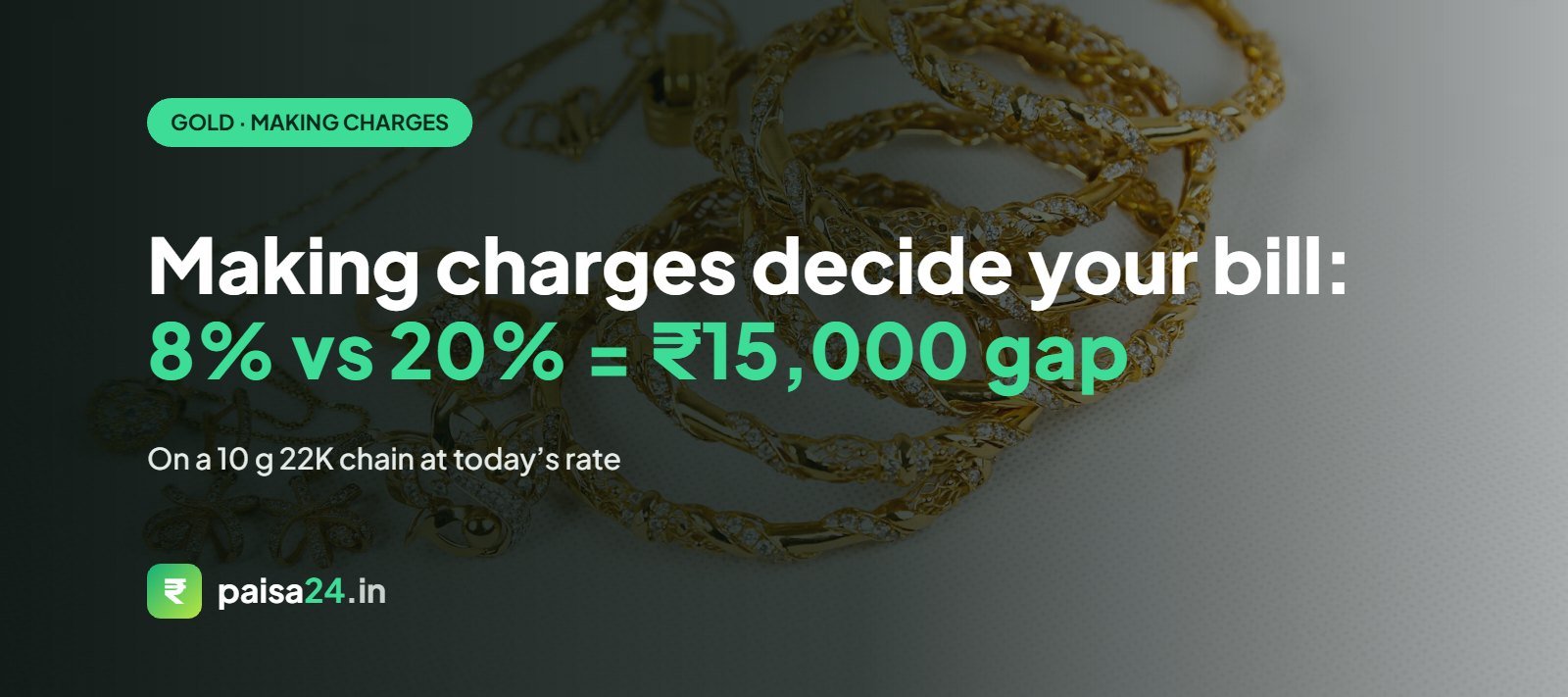
Now compare the same 10 g chain at different making charges. The gold is identical, yet the final price moves a lot.
| Making charge | Making amount | GST | Final price |
|---|---|---|---|
| 8% | ₹10,268 | ₹4,159 | ₹1,42,777 |
| 12% | ₹15,402 | ₹4,313 | ₹1,48,065 |
| 20% | ₹25,670 | ₹4,621 | ₹1,58,641 |
In other words, the gap between 8% and 20% is about ₹15,864 on a single chain. That is why comparing making charges across two or three shops pays off more than waiting for a ₹200 dip in the gold rate.

Hallmark checks before you pay
Purity matters as much as the gold jewellery price calculation itself. BIS hallmarking with a 6-digit HUID is mandatory for gold jewellery sold in India (with small exemptions, such as pieces under 2 grams). Look for three marks on every piece:
- BIS standard mark (the triangle logo).
- Purity grade, such as 22K916.
- HUID, a 6-digit alphanumeric code unique to that piece.
Then enter the HUID in the free BIS CARE app. It shows the purity, the jeweller and the hallmarking centre. If the details do not match the bill, do not buy.
Exchanging or selling old gold
- The gold jewellery price calculation works in reverse when you sell. The jeweller tests purity, often with an XRF machine, and values only the pure gold.
- Exchange rates are usually below the selling rate, and deductions vary by shop, so ask for the deduction in writing.
- If you sell for cash and have held the gold for more than 24 months, gains are long-term and taxed at 12.5% without indexation. Otherwise, gains are added to your income and taxed at slab rates.
Also note the cash rules. Jewellers ask for PAN on high-value purchases above ₹2 lakh, and cash receipts of ₹2 lakh or more in one transaction are not allowed. So pay by UPI, card or bank transfer for big bills.
7 tips to cut your gold jewellery price calculation
- Check the day’s 22K rate on two sources before you go.
- Ask for net weight and making charges in rupees.
- Compare at least three jewellers on making charges.
- Prefer simple, machine-made designs for investment-like buys.
- Check the HUID on the BIS CARE app.
- Keep the bill. You need it for resale, exchange and tax.
- If you only want gold as an investment, compare options in our gold rate guide before paying making charges at all.
FAQs on gold jewellery price calculation
What is the formula for gold jewellery price calculation?
Gold rate per gram × net weight, plus making charges, plus 3% GST on the total.
Is GST on making charges 5% or 3%?
On finished jewellery you buy, GST is 3% on the full value, including making charges. The 5% rate applies to job work on gold you supply.
Why is my bill higher than the gold rate in the news?
News usually quotes the 24K rate before GST. Your bill adds making charges and 3% GST, and it may use a slightly different local rate.
How do I check if my gold is genuine?
Check the BIS logo, purity grade and 6-digit HUID, then verify the HUID on the BIS CARE app.
Sources: Upstox gold rate, 12 Nov 2026, Kotak Neo on gold tax, Bureau of Indian Standards (BIS CARE app). Rates are indicative; your jeweller’s rate may differ.
Keep exploring on Paisa24
🧮 Free calculators for this topic
- GST Calculator — add or remove GST in one click
- SIP Calculator — see what your monthly SIP grows to
- FD Calculator — maturity and interest on any FD
📚 Related reads
This guide is for information only and isn’t financial advice. Rates, fees and rules change — always confirm on the official website before you decide. Read our disclaimer.