Crypto Tax in India 2026: 30% Tax, 1% TDS & Loss Rules Explained
Crypto tax in India in 2026: 30% flat tax on profits, 1% TDS on sales, no loss set-off, with a worked example and how to report it in your ITR.
On this page 7 sections
Crypto prices swing every day, but crypto tax in India stays strict and simple: a flat 30% on profits, 1% TDS on sales, and no relief for losses. If you trade or hold Bitcoin, Ethereum or any other token, here is exactly how the tax works on your gains in 2026, with examples, the TDS rules and how to report it in your return.
Key takeaways
- Profits from crypto and other virtual digital assets (VDAs) attract a flat 30% tax, plus cess and any surcharge.
- You can deduct only what you paid to buy the asset: no fees, no losses from other coins.
- A 1% TDS applies when you sell, once your yearly sales cross the threshold.
- Losses on one coin do not reduce gains on another, and you cannot carry them forward.
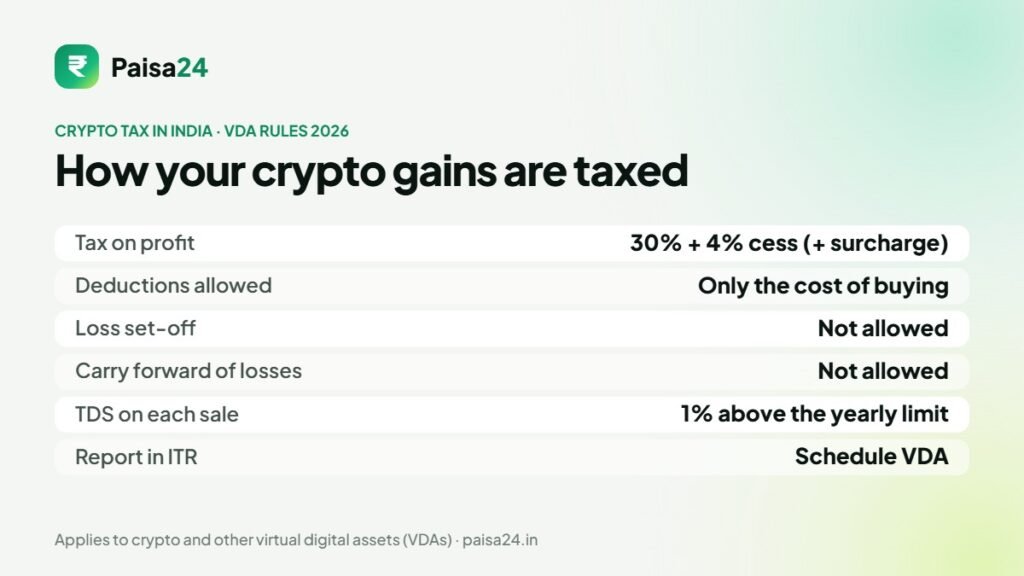
How crypto tax in India works
Indian tax law calls crypto a “virtual digital asset” (VDA). This covers cryptocurrencies, NFTs and similar tokens. Since 2022, any income from transferring a VDA attracts a special flat rate, regardless of your income slab or how long you held the asset.
| Crypto tax in India rule | What it means for you |
|---|---|
| 30% flat tax | Applies to every rupee of profit, even if your other income is low |
| 4% cess + surcharge | Added on top, as for other income |
| Only cost deductible | You cannot deduct exchange fees, internet or other expenses |
| No loss set-off | A loss on one coin cannot reduce profit on another |
| No carry forward | Unused losses lapse at year-end |
| Gifts taxed | A crypto gift can be taxable for the receiver above limits |
Crypto tax in India: worked example
Say Arjun buys ₹1,00,000 of Bitcoin and ₹50,000 of another token. Later, he sells the Bitcoin for ₹1,60,000 and the token for ₹30,000.
| Bitcoin | Other token | |
|---|---|---|
| Bought for | ₹1,00,000 | ₹50,000 |
| Sold for | ₹1,60,000 | ₹30,000 |
| Profit / loss | ₹60,000 profit | ₹20,000 loss |
| Taxable | ₹60,000 | Loss ignored |
As a result, under crypto tax in India, Arjun pays 30% on the full ₹60,000, that is ₹18,000, plus 4% cess, so ₹18,720 in total. The ₹20,000 loss does not reduce his tax at all. In other words, his net gain was ₹40,000, but he pays tax on ₹60,000.
The 1% TDS on crypto sales
Crypto tax in India also uses TDS: when you sell, the exchange deducts 1% of the sale value. Indian exchanges deduct it automatically. You can compare crypto’s risk with steady options in our SIP calculator. It applies once your yearly sales cross ₹50,000 for “specified persons” (broadly, individuals without business audit) or ₹10,000 for others.
- TDS is not an extra tax. Instead, it is an advance that shows in your Form 26AS and counts against your final tax.
- If your total tax is lower than the TDS, you can claim the difference as a refund in your return.
- On peer-to-peer or foreign platforms, the buyer may have to deduct TDS, so check before you trade.
Watch out: Trading on foreign exchanges does not avoid crypto tax in India. Indian residents must report worldwide income, and tax authorities increasingly receive data from exchanges.
How to report crypto tax in India in your ITR
- Collect your trade history from every exchange and wallet for the year.
- Work out profit per transfer: sale value minus purchase cost, one transaction at a time.
- Fill Schedule VDA in your income tax return with dates, cost and sale value.
- Match your TDS with Form 26AS or the annual information statement (AIS).
- Pay any balance tax before filing, to avoid interest.
For crypto tax in India, most investors file ITR-2, while those treating it as business income file ITR-3. You can file on the income tax e-filing portal.
Is crypto legal in India?
Crypto tax in India exists because owning and trading crypto is not banned here, and Indian exchanges must register with the Financial Intelligence Unit (FIU-IND) under anti-money-laundering rules. However, crypto is not legal tender, and the RBI has repeatedly warned about its risks. So treat it as a high-risk asset and invest only what you can afford to lose. For safer goals, see our free money calculators.
Smart moves for crypto investors
- Keep records for crypto tax in India: log every trade, including transfers between wallets.
- Avoid frequent small trades: because losses do not offset gains, active trading can mean paying tax even in a losing year.
- Use registered Indian exchanges for clean TDS records.
- Keep crypto a small part of your portfolio, alongside safer options like SIPs and PPF. See our 80C deductions guide for tax-efficient choices.
Frequently asked questions
What is the tax rate on crypto in India?
Under crypto tax in India, profits from crypto and other VDAs face a flat 30%, plus 4% cess and any applicable surcharge.
Can I set off crypto losses against gains?
No. A loss on one VDA cannot reduce gains on another or any other income, and you cannot carry it forward.
Is TDS deducted on crypto in India?
Yes. 1% TDS applies on the sale value once your yearly sales cross ₹50,000 (₹10,000 for some persons). It counts towards your final tax.
Which ITR form should I use for crypto?
Most investors use ITR-2 and fill Schedule VDA. If you trade as a business, use ITR-3.
Is crypto banned in India?
No. Owning and trading crypto is allowed, but it is not legal tender and the tax on it is heavy.
Sources: Income Tax Department · FIU-IND. Last checked 21 October 2026. Figures are estimates for guidance, not tax or financial advice.
This guide is for information only and isn’t financial advice. Rates, fees and rules change — always confirm on the official website before you decide. Read our disclaimer.