Income Tax Slabs FY 2026-27: New vs Old Regime Rates Explained
Income tax slabs for FY 2026-27 under the new and old regimes, with worked examples, the ₹12 lakh rebate, surcharge and what the new Income Tax Act changed.
On this page 11 sections
- 01Income tax slabs FY 2026-27 under the new regime
- 02Old regime income tax slabs for FY 2026-27
- 03Income tax slabs in action: tax on common salaries
- 04How to calculate your tax using the income tax slabs
- 05Income that sits outside the income tax slabs
- 06When does the old regime still win?
- 07Surcharge and cess
- 08Deductions you can still claim in the new regime
- 09What the new Income Tax Act, 2025 changes
- 10How to choose your regime in 3 steps
- 11Frequently asked questions
The income tax slabs for FY 2026-27 are the same as last year, because Budget 2026 left them untouched: under the new regime, income up to ₹4 lakh is tax-free and the top 30% rate starts above ₹24 lakh. Thanks to the rebate, a salaried person earning up to ₹12.75 lakh pays zero tax. This guide gives you both regimes, worked examples and the rules that changed with the new Income Tax Act.
Key takeaways
- Budget 2026 did not change any slab or rate — the FY 2025-26 structure continues for FY 2026-27.
- New regime: zero tax up to ₹12 lakh taxable income, which is ₹12.75 lakh of salary after the ₹75,000 standard deduction.
- Old regime slabs are unchanged too: 5%, 20% and 30%, with a ₹50,000 standard deduction.
- From 1 April 2026 the Income Tax Act, 2025 replaces the 1961 Act, and “FY + AY” becomes a single “tax year”.
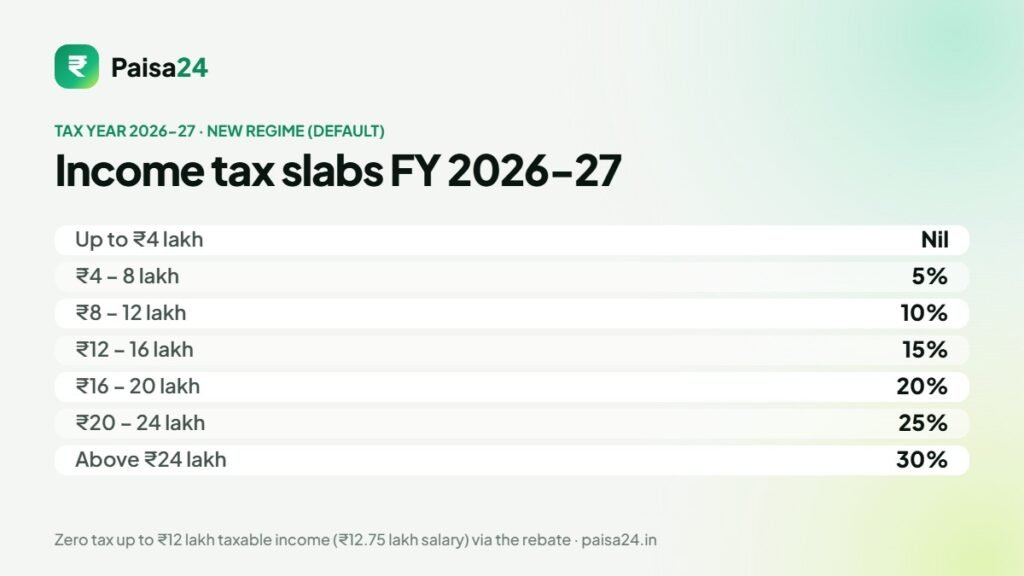
Income tax slabs FY 2026-27 under the new regime
First, note that the new regime is the default. If you do not choose a regime, your employer and the tax department apply these rates. They work on your taxable income, which for a salaried person is salary minus the ₹75,000 standard deduction.
| Taxable income | Tax rate | Tax on this slab (max) |
|---|---|---|
| Up to ₹4,00,000 | Nil | ₹0 |
| ₹4,00,001 – ₹8,00,000 | 5% | ₹20,000 |
| ₹8,00,001 – ₹12,00,000 | 10% | ₹40,000 |
| ₹12,00,001 – ₹16,00,000 | 15% | ₹60,000 |
| ₹16,00,001 – ₹20,00,000 | 20% | ₹80,000 |
| ₹20,00,001 – ₹24,00,000 | 25% | ₹1,00,000 |
| Above ₹24,00,000 | 30% | — |
The ₹12 lakh rebate: why most salaries pay zero tax
For example, if your taxable income is ₹12 lakh or less, a tax rebate cancels your tax completely (up to ₹60,000). So a salary of ₹12.75 lakh becomes ₹12 lakh after the standard deduction, and the tax is nil. The rebate applies to normal income; however, special-rate income such as capital gains follows its own rules.
Marginal relief just above ₹12 lakh
But what if you cross ₹12 lakh by a small amount? Marginal relief makes sure your tax is never more than the income above ₹12 lakh. For example, at ₹12.10 lakh taxable income the slab tax is ₹61,500, but you pay only ₹10,000 (plus cess), because you earned just ₹10,000 above the limit.
Free calculatorCalculate your exact tax in both regimesNew vs Old regime for FY 2026-27 — see which one saves you more, instantly.Old regime income tax slabs for FY 2026-27
On the other hand, the old regime has higher rates but lets you claim deductions such as 80C, 80D, HRA and home loan interest. Its slabs depend on your age.
| Taxable income | Below 60 | 60 to 80 | 80 and above |
|---|---|---|---|
| Up to ₹2,50,000 | Nil | Nil | Nil |
| ₹2,50,001 – ₹3,00,000 | 5% | Nil | Nil |
| ₹3,00,001 – ₹5,00,000 | 5% | 5% | Nil |
| ₹5,00,001 – ₹10,00,000 | 20% | 20% | 20% |
| Above ₹10,00,000 | 30% | 30% | 30% |
Also, in the old regime, the standard deduction is ₹50,000 and the rebate covers taxable income up to ₹5 lakh (maximum ₹12,500).
Income tax slabs in action: tax on common salaries
To make this concrete, here is the total tax (including 4% cess) for a salaried person below 60. For the old regime we assume ₹1.75 lakh of deductions (₹1.5 lakh under 80C and ₹25,000 under 80D), which is typical.
| Annual salary | New regime tax | Old regime tax | Better choice |
|---|---|---|---|
| ₹7 lakh | ₹0 | ₹0 | Either |
| ₹10 lakh | ₹0 | ₹70,200 | New |
| ₹12.75 lakh | ₹0 | ₹1,32,600 | New |
| ₹15 lakh | ₹97,500 | ₹2,02,800 | New |
| ₹20 lakh | ₹1,92,400 | ₹3,58,800 | New |
| ₹25 lakh | ₹3,19,800 | ₹5,14,800 | New |
| ₹30 lakh | ₹4,75,800 | ₹6,70,800 | New |
How we calculated ₹15 lakh: Taxable income = ₹15,00,000 − ₹75,000 = ₹14,25,000. Tax = ₹20,000 (4–8 lakh) + ₹40,000 (8–12 lakh) + ₹33,750 (15% on ₹2,25,000) = ₹93,750. Add 4% cess and the total is ₹97,500.
How to calculate your tax using the income tax slabs
You can work out your tax by hand in five steps. In fact, it is worth doing once, because it shows you exactly where each rupee of tax comes from.
- Start with gross income: salary, interest, rent and any other income for the year.
- Subtract exemptions and deductions: the ₹75,000 standard deduction in the new regime, or ₹50,000 plus 80C, 80D, HRA and others in the old regime.
- Apply the slabs: tax each slice of income at its own rate. In other words, each slab’s rate applies only to the income inside that slab, not to your whole income.
- Apply the rebate and marginal relief: if taxable income is within ₹12 lakh (new) or ₹5 lakh (old), the tax becomes nil.
- Add surcharge and 4% cess: then subtract the TDS already deducted to see what you owe or get back.
Common mistake: Many people think crossing a slab means the higher rate applies to their whole income. That is not true. Moving from ₹15.9 lakh to ₹16.1 lakh taxable income only taxes the extra ₹10,000 at 20%.
Income that sits outside the income tax slabs
Some income has its own fixed rates and sits outside the income tax slabs for FY 2026-27. Capital gains on shares and mutual funds, lottery winnings and some other special incomes carry their own fixed rates. They also do not get the ₹12 lakh rebate in the new regime. If you sold shares or funds this year, check the capital gains rules separately before relying on the zero-tax limit.
Similarly, interest from savings accounts, fixed deposits and post office schemes is normal income, so you add it to your salary and pay tax on it at your slab rate. Use our FD calculator to see how much interest you will earn in the year.
When does the old regime still win?
However, the old regime only wins when your deductions are large. We worked out the break-even point: the total deductions (beyond the standard deduction) at which both regimes cost the same.
| Salary | Deductions needed for old regime to match new |
|---|---|
| ₹10 lakh | About ₹4.5 lakh |
| ₹15 lakh | About ₹5.4 lakh |
| ₹20 lakh | About ₹7.1 lakh |
| ₹25 lakh and above | About ₹8 lakh |
As a result, to reach these numbers you usually need a big HRA exemption and home loan interest of up to ₹2 lakh, on top of 80C and 80D. Read our full comparison: new vs old tax regime.
Surcharge and cess
In addition, every taxpayer pays a 4% health and education cess on the tax. High earners also pay a surcharge on the tax:
| Taxable income | Surcharge (new regime) | Surcharge (old regime) |
|---|---|---|
| ₹50 lakh – ₹1 crore | 10% | 10% |
| ₹1 crore – ₹2 crore | 15% | 15% |
| ₹2 crore – ₹5 crore | 25% | 25% |
| Above ₹5 crore | 25% (capped) | 37% |
Deductions you can still claim in the new regime
Although the new regime removes most deductions, a few still remain. These can lower your tax even if you never invest in tax-saving products:
- Standard deduction of ₹75,000 on salary or pension.
- Employer’s NPS contribution up to 14% of basic salary plus DA.
- Family pension deduction of up to ₹25,000.
- Agniveer Corpus Fund contributions, where applicable.
On the other hand, deductions such as 80C, 80D, HRA and home loan interest on a self-occupied house are available only in the old regime. Use our HRA calculator to see what your HRA exemption is worth.
What the new Income Tax Act, 2025 changes
Meanwhile, from 1 April 2026, the Income Tax Act, 2025 replaced the 61-year-old 1961 Act. It is about half the length (536 sections against more than 800), but the government designed it to be revenue-neutral, so no rate or slab changed.
- Tax year: one “tax year” now replaces the old “previous year” and “assessment year” (1 April to 31 March). FY 2026-27 is tax year 2026-27.
- New section numbers: 80C is now Section 123, 80D is 126, NPS (80CCD) is 124 and the 87A rebate is 156.
- Revised returns: you get until 31 March (instead of 31 December) to file a revised return, with a small fee.
Pro tip: Your income tax slabs for FY 2026-27 decide your TDS too. Tell your employer your regime choice early in the year, so that the right TDS comes out of every salary and you avoid a big bill in March.
How to choose your regime in 3 steps
- Add up your deductions: 80C, 80D, HRA exemption, home loan interest and NPS (80CCD(1B)).
- Compare with the break-even table above for your salary.
- Run both regimes in our income tax calculator and pick the lower one. Salaried people can switch every year when filing their return.
Frequently asked questions
What are the income tax slabs for FY 2026-27?
Under the new regime: nil up to ₹4 lakh, 5% up to ₹8 lakh, 10% up to ₹12 lakh, 15% up to ₹16 lakh, 20% up to ₹20 lakh, 25% up to ₹24 lakh and 30% above that. The old regime has nil up to ₹2.5 lakh, 5% up to ₹5 lakh, 20% up to ₹10 lakh and 30% above.
Did Budget 2026 change the tax slabs?
No. Budget 2026 kept the slabs, rates, standard deduction and ₹12 lakh rebate unchanged for FY 2026-27.
Is income up to ₹12 lakh tax-free?
Yes, in the new regime. Taxable income up to ₹12 lakh gets a full rebate, so salaried people pay no tax up to ₹12.75 lakh of salary.
Which regime is the default?
The new regime is the default. You must choose the old regime actively if you want it.
Can I switch between regimes every year?
Salaried individuals can choose either regime every year when filing the return. People with business income can switch back only once.
Sources: Income Tax Department · Union Budget 2026-27 · Income Tax Act, 2025 overview. Last checked 21 October 2026. Figures are estimates for guidance, not tax or financial advice.
This guide is for information only and isn’t financial advice. Rates, fees and rules change — always confirm on the official website before you decide. Read our disclaimer.